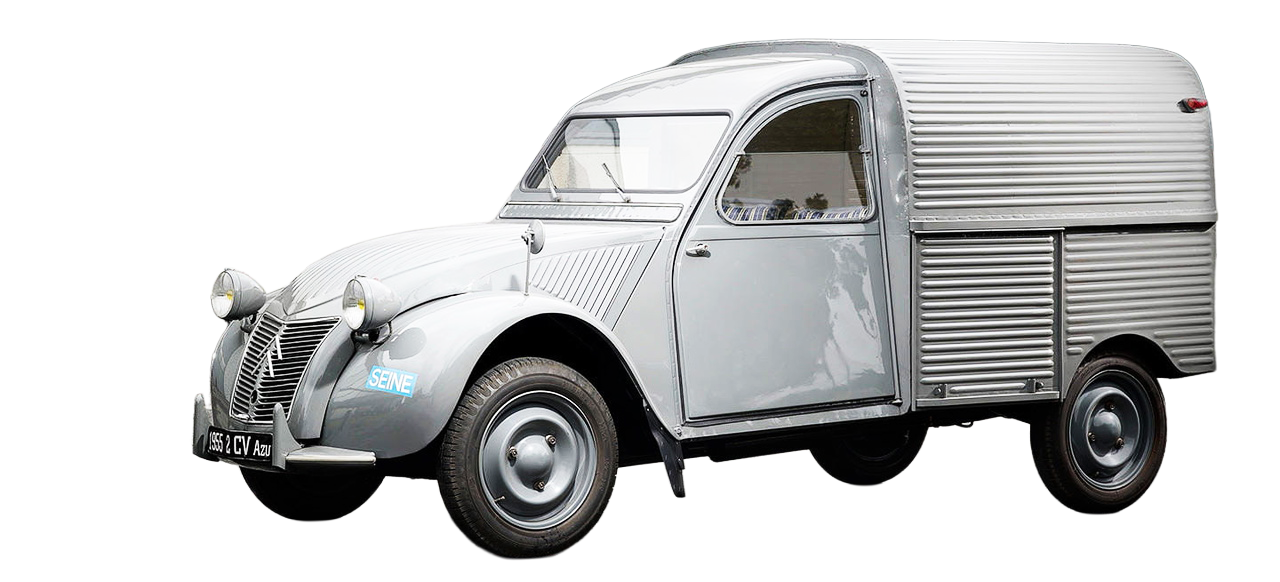
A model of the French ‘Citroën 2CV’ van, which was launched in 1951
When it comes to toys, I have two memories of them. In the first, I see myself in an empty plot of land; it’s opposite my house and unfenced, as most were back then; I’m making mud balls, shaping them by taking a small pile of clayey soil, the ground there was almost entirely clay, which I’d dampened with water beforehand. Skillfully, I spun the ball on a flat piece of wood; after a few turns, it took on a round shape, and they turned out quite well:
«These balls (marbles) will be brilliant! I need to make these two a bit smaller,» I thought to myself.
I also made another lump the size of my hand and, with great patience and imagination, shaped it like a skilled craftsman. Until it began to resemble a delivery van, I wanted to recreate a ‘Citroën’ (very popular in those days); I finished off the details with a toothpick; to my eyes it looked the part, though not so to those of my ‘little mates’, who were the ones I was trying to sell them to. And they had no qualms about making that clear to me when they came over to examine my wares:
“This doesn’t look anything like a ‘Citroën’!”
“Don’t you like it either?” I asked another friend who was with him.
“Don’t get mad, but I wouldn’t pay a penny for this.”
From the looks of it, they thought it looked more like a piece of shit than a van – what the hell do these useless lot know about art! They didn’t appreciate the effort it took me to make them yet again. Especially convincing my mum to let me put them in the oven, where they were baked or toasted; more the latter, really, as I couldn’t quite get the cooking times right:
"Here you go again with this rubbish! Remember last time there were splashes all over the oven; I spent the whole morning cleaning it."
Ignoring her complaint, I carried on with my plan, trying to win her approval for my work; to be honest, I wanted to make her feel sorry for me!
"It’s taken me ages to make these! Where’s the baking tray?"
"It’s in the pantry, where you left it last time."
I went to fetch it; it was an old baking tray that fitted perfectly; my mum had given it to me for this very purpose.
"How long should we bake them for this time?" I asked.
I replied to my mum, whilst carefully placing my creation of balls and vans onto the tray:
“Thirty minutes will be enough, but turn the oven up to full heat.”
“At your service, boss!” my mum replied ironically.
So she did; she placed the tray roughly halfway down the oven and set the temperature to about 200 degrees.
Throughout the baking time, I kept a close eye on things to make sure they didn’t explode, and when the time was up, the ‘CLINK’ of the end sounded:
"Move away, you might get burnt!"
My mum took the dish out, using oven gloves, and placed the piping-hot tray on the kitchen worktop.
A few hours later, which I spent playing on our terrace, my mum put the now-cool dish on the kitchen table.
“Right, you can have them now! Wait till I touch the balls!”
“Ouch, aaah…!” She always played that joke on me, making me think she’d burnt herself, and I always fell for it:
“I’m sorry, Mum, I didn’t mean to…!”
“That’s a lie, darling!”
Once the scare was over, I gathered the items and took them out to the terrace, where my storage space was under the sink. They didn’t stay there long, as my list of friends and potential customers was extensive; and not everyone was as ‘fussy’ as the first few I asked. And if I had any ‘leftovers’, I’d always give them to one of my mother’s customers; just as I did last time. They took them to look good, I suppose they’d throw them in the bin later…
The second memory is of the other toys, the real ones, which came from the United States, yes, from North America; that was possible thanks to the solidarity and love of my Aunt Raquel (may she be in heaven, reunited with her husband, Uncle Erwin, enjoying their little animals, which they loved so much, especially the dogs), towards her sister’s children, ‘that is to say’, us…
She had moved there, specifically to the state of Ohio, after marrying an American doctor whom she had met in Barcelona. Although on this occasion, our shipment of toys was ‘up in the air’, never a truer word spoken, since in that year of 1962, a few months earlier, we had been on the brink of the end of our civilisation…:
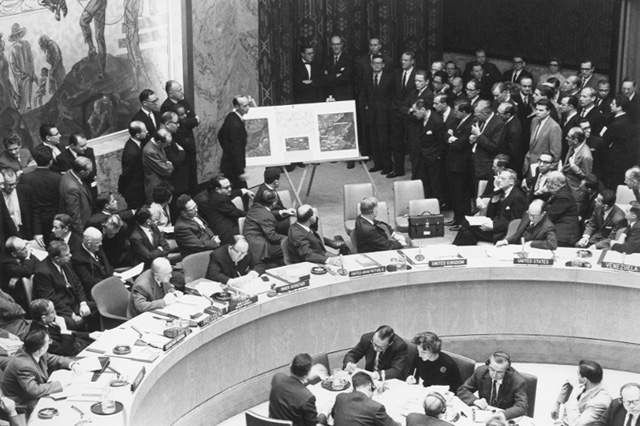
The US Ambassador to the United Nations, Adlai Stevenson, shows aerial photographs of Cuban missiles to the United Nations on 25 October 1962.
In October, a US spy plane flying over the island of Cuba photographed some missile launch pads.
In response, US President 'Kennedy' imposed a naval blockade on the Caribbean island and sent messages to the Russians, instructing them to withdraw their weapons and turn back their ships, which were heading towards the island laden with more missiles.
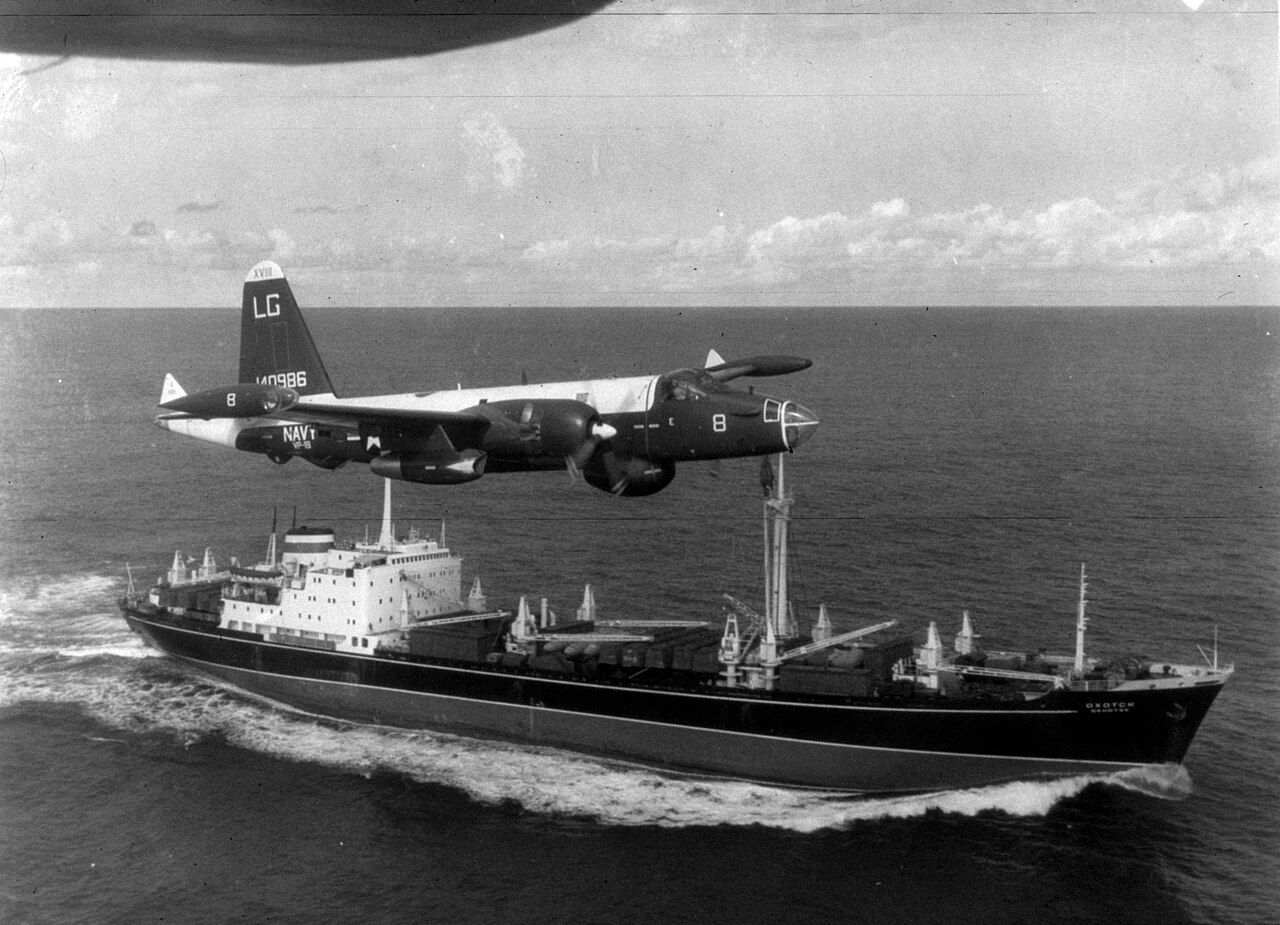
A US Navy P-2H Neptune from VP-18 flying over a Soviet cargo ship.
For a few days, the world was on the brink of nuclear annihilation, but in the end, the Russians agreed to withdraw their weapons and ordered their ships to return, and everything went back to normal; civilisation was saved and we would get our toys.
…A month later, and about a month before Christmas, my aunt, as was her custom, sent a large parcel intended to bring us the joy typical of the festive season. Almost always, it was I who accompanied my mother to a warehouse near the main post office in the city centre. I believe the name of the transport agency was ‘La Expeditiva’ (a transport company founded in 1905 by Bartolomé Miralles Vidal, and taken over in 1940 by his son of the same name, who ran it until 1996). This company seemed to have the exclusive right to collect and deliver parcels; they all arrived via it. Every time we went there, we followed these steps:
After queuing for a long time, the clerk would place the parcel on a large scales; it was the one identified by a notification previously handed to us by the postman. The parcel was tied with string, and on this occasion it hadn’t been opened and resealed, as had happened on more than one occasion. They said it was the customs officials, who were checking that there was no contraband or black-market goods inside.
"Bloody hell, it’s heavy! This is the one that matches this number, let’s see, consignment 3527… and from the US, this is definitely it!"
"Let me have a look!" said my mother, examining it to see if it had been opened before.
"Listen! If you’re not happy with it, leave it here and we’ll send it back to the sender."
“Bloody hell, I can have a look, can’t I?!”
“Madam, don’t be rude to me, I haven’t been rude to you!”
Seeing the situation, I instinctively took my mother’s hand and held it out, to calm her down and stop the ‘lioness’ inside her from coming out. My mother realised what I was doing and this time she listened to me; it wasn’t worth arguing with a ‘blockhead’ like that. It seemed the uniform had gone to his head, yet another man in uniform! Everyone was wearing military style clothes and caps: taxi drivers, chauffeurs and even the shoe shiners. Although the one serving us looked more like a grey cape, altered and in poor taste.
"Excuse me! But every year the parcel arrives showing signs of having been opened, and with things missing."
"Well, in such cases you should report what you’re saying, but not to me, I’m just a ‘nobody’! You must report it to the manager, who is that man (pointing at him), and whose only job all day is to deal with complaints,” he said sarcastically. “And now make up your mind, look at the queue that’s formed! Do you want it or not? If you don’t collect it, we’ll hand it over to customs for inspection!”
The boss’s threat had already been issued, though my mother knew the situation was under control. The truth is that Aunt Raquel, ever the shrewd one, had been told by my mother about the inspections, and always sent the toys without their original boxes, sometimes wrapped in rags—whatever it took to make it clear they weren’t intended for sale.
“You know what…! I don’t see any need for you and me to argue, I’ll take it!”
“Better that way!” We didn’t know if it was a conciliatory remark or a vague threat, nor did it matter; we already had the box with the presents.
My mother let me hold one of the ropes that tied it down too, so I felt like I was the one carrying it:
“Come on, Antoñito, grab the rope, I can’t manage it on my own!”
“But I can’t hold it! Move over a bit and let me have a go too.”
With the heavy load, that day, instead of going back by bus, we took a taxi. We wouldn’t have been able to get to the bus stop, and besides, they wouldn’t have let us on the bus with such a huge bundle.
“Let’s go to that taxi over there, it’s free… Taxi, taxi!” she shouted, waving her hand and gesturing for it not to move, as it already had new customers, us…
The taxi driver, seeing how heavily laden we were, got out of the car and went round to the back, where he opened the boot; it seemed enormous to me, I don’t remember what make it was; it looked like one of those used in American gangster films.
“Madam, bring the parcel over here!” It was clear that the bloke hadn’t seen me, even though I was the one actually carrying the bundle. “What’s inside the bundle, madam?”
«What the hell does this other uniformed bloke care!». I thought to myself.
"Nothing! Just a few bits and bobs my sister sent me; she lives in America." My mother went on at length, explaining things to the curious taxi driver. ‘You catch more flies with honey than with vinegar,’ which teaches us that to win someone over, the best approach is kindness...
"Well, let me take it; I’ll put it in the boot." he said, and he did.
It didn’t bother me that he referred to our toys as “a few bits and bobs”…
My mother told me there were clothes inside, though I knew full well that the presents were inside. Nor did he try to deceive me by saying otherwise; it all made sense: these presents came from Aunt Raquel’s Father Christmas, a custom not yet deeply rooted in Spain, this ‘Noel’ business, who sent them in advance. And in the end they were mixed in with the other toys, and we all received them on Three Kings’ Day, depending on how we’d behaved throughout the year.
A child, when interested, is the easiest to convince! We’d better leave it at that and not get into whether he was already aware of the true nature of the Three Kings.
I cared little about where each of them came from; what mattered was what sort of toys they were.
"Where are we heading?"
asked the driver.
“Well, to ‘Botella’ Street, number ‘Tapón’.”
The names which the taxi driver actually heard, but which I’m omitting for security reasons, were familiar and instantly recognisable to him; he’d surely been to that area before.
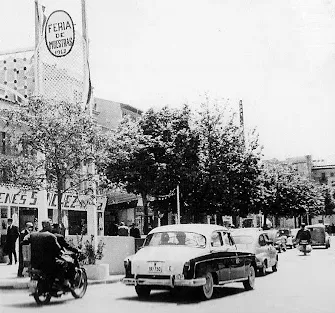
A photograph of a taxi similar to the one we took, which is shown driving along the street known as the ‘Avenidas’, one of the main thoroughfares in the city of Palma de Mallorca, a route we simply had to take, as was the case for us back in 1962. This coincided with the ‘Feria de Muestras’ fair being held there, which is what the photo captures.
“Do you often come down our street?” my mother asked, wondering if she might know him from somewhere.
“Well, yes! There’s a gentleman called Don Juan, who’s missing a leg, whom I sometimes take to the clinic.”
“Well, wouldn’t you know it, we know him too! Next time you see him, tell him we went for a ride with you. And I won’t give you any more directions now; I’m sure you know the way better than I do.” The taxi driver smiled and off we went, to our home; when we arrived:
"Right, we’re here, madam. You owe me twelve pesetas!" For the younger lot, that was the currency we used in Spain before the introduction of the ‘euro’ (1 Euro = 166.386 pesetas)
“Here, I’ll give you thirteen pesetas and keep this extra one for your kindness!”
“Thank you very much, madam!”
After putting the money in a small metal box, he went round to the back, opened the boot and took out the parcel, which he’d barely managed to fit in there before.
“Come on, Antoñito, help me carry it up the stairs!”
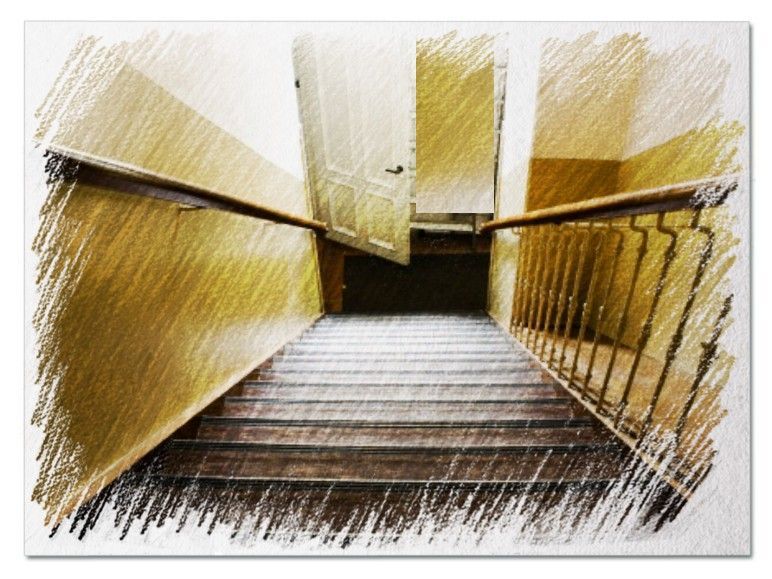
Just thinking about our steep staircase made our hair stand on end...
But this wasn’t necessary, for my two brothers came down the aforementioned ‘steep’ staircase, the one in our house, and, like the strong, sturdy young men they were, they grabbed the bundle and carried it all the way upstairs. My mother watched them with pride; suddenly she paid no more attention to me, what could we do about it!: «The last shall be first, and the first shall be last» (Matthew 20:1–16).
“Be careful not to hurt yourselves, it’s very heavy!”
“Don’t worry, Mum, we’re grown, ups now; we can handle this and much more!”
The box, as in previous years, was placed in my parents’ bedroom, thus avoiding the temptation for us to snoop through its contents.
A few days later, and of course before the toys were handed out, my mother, as she did every year, would secretly check them, using as a guide a letter inside the box that Aunt Raquel had placed there. She assigned the toys to each of us according to who they were meant for; Aunt Raquel was very ‘crafty’ and, knowing our ages as she did, had already allocated the toys to us. My mum respected this arrangement, though not entirely; with some of them, she made changes to the recipients as she saw fit, ‘that’s why she gave birth to us!’, as she always argued. And no one was going to tell her what each of us was like.
"This one’s for Leo, who likes building things; I don’t know why Raquel’s given it to Damián!" she also had a habit, on occasion, of talking to herself; I’d heard her doing it more than once.
The sorting went on until she’d distributed them all; as most were missing their original packaging, she put them in boxes, writing the name of their future owner on each one. Many of them were shoe boxes, which she’d been saving up throughout the year for the occasion.
The idea was to give us a bit of excitement when we unwrapped the toy and to get us into the ‘Christmas spirit’.
…On Three Kings’ Day, first thing in the morning, near a nativity scene we’d set up in a corner of the dining room, we ‘unwrapped the presents’.
I was the first to search through the boxes for the ones with my name on them; my brothers let me do it, as they’d already stopped believing in the ‘Three Kings’.
A few minutes later, without waiting for me to finish ‘checking’ all the presents, my siblings took control and found their own presents.
"This one’s for me! It’s got my name on it," Leo claimed.
"And this one’s for me!" Damián didn’t want to be left out of the spoils.
Within minutes, the presents had been picked up and taken away by each of their recipients. And as if imitating dogs, all of us, although we were looking at our own presents, were more interested in each other’s. Dogs do the same with bones or food; what could we do? Deep down, we’re all animals…
The other toys, the ones from the Spanish Three Kings, were more ordinary and predictable; mine was a ball, which, given the material it was made of, wasn’t expected to last long. One of my brothers was given a ‘Geyper Game Set’; it really annoyed me as it was a toy I’d wanted.
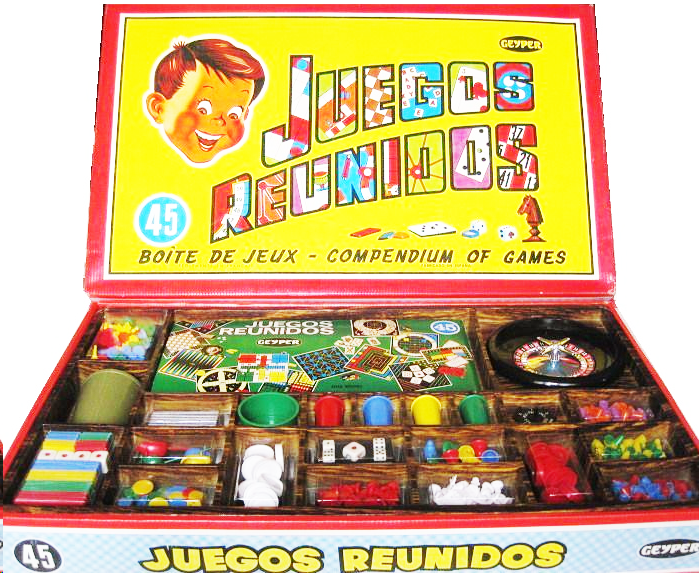
Every child wanted this gift, which was available in different sizes and contained a wide variety of games.
These games, which first appeared in 1945, consisted of a large, beautifully designed box containing a huge variety of board games. They came in various sizes depending on the number of games they contained: 10, 15, 25, 35, 45, 50 or 55 games. There were the most popular ones, the ones we all knew, children and adults alike, such as Parcheesi, Goose, Checkers, Chess and even Roulette, complete with its mat and even its little ball, which was the first thing to go missing.
To these had been added all sorts of games; I’ll mention a few just to remind you that there are board games as well as ‘little consoles’: Jacks, Take and Put, Marbles, Indian Race, Wild, The Hunt, Ketekojo, Add and Multiply, Dernier, Take, Noughts and Crosses, Squares, Words, From Power to Power, Jaquet, Sempre Avanti,
Rush, Halma, In-Out, Speed Halma, 421, Gobang, Pyramid, Tippy, Assault Game, Pentaline, Chalma, Meta 24, Chinese Checkers, Marelle, Derby, Quinielas, Flea Game, Dice, Tira, Cheeky, Raffles, The Wheel, Sole Fishing, Lotto, Snakes and Ladders.
There was no shortage of different decks of cards for playing solitaire, poker, rummy, etc. etc… The company that made them was 'Industrias Geyper', owned by Antonio Pérez Sánchez.
When we showed off our toys the next day, it was a sort of competition to see which ones were the best.
We were the envy of the other children; ours were American, and nobody else had them. I was the first to have a sort of 'Madelman', a plastic cowboy and Indian about 30 centimetres tall, very well made, which were articulated and could strike “poses”; these figures were complemented by a range of accessories, such as a canteen, a bow and arrows, a pistol and a little bag that looked exactly like a purse down to the smallest detail.
“Come on, Billy, get your gun out!”
“Your cowboy’s much bigger than mine!”
“I know, ‘Michel’, this one’s made in America!”
“I’ll swap it for my ‘colouring box’!” that was what my friend treasured most, a huge box full of crayons in every colour.
“What the hell do you mean ‘crayons’? I wouldn’t swap this for anything!”
Another present I received that I continued to love for years, a rare thing for a child to like a present for more than just one Christmas, was like a Spanish ‘Exin Castillo’. I can’t quite remember its name; ‘Skyscraper Builders’ might fit the bill and give you an idea. It contained a whole variety of white plastic pieces, with which you could build a skyscraper, very American! It had windows, walls and even a tower spire with a long antenna. I reckon even today, I might still find a piece or two at my mum’s house...
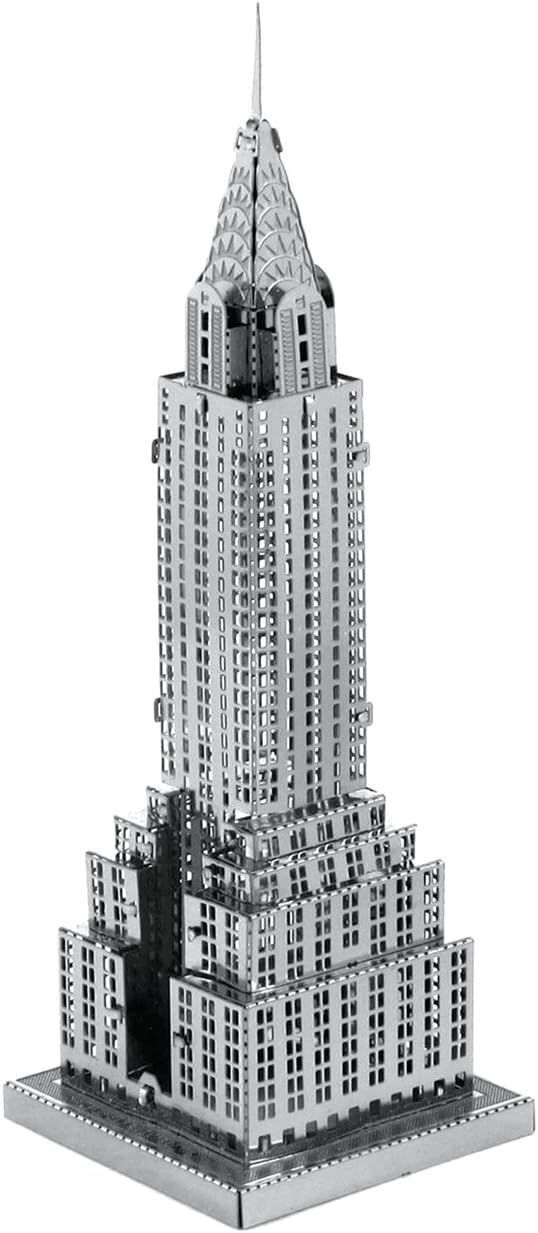
This photo of the game is spot on; it was crafted down 'to the very last detail' the only thing missing were the workers, who, in this case, were you and your mates.
He also used to send lots of ‘puzzles’, but as they didn’t come with their original boxes, to put them together you had to rely on a sort of template, made from the puzzle’s promotional leaflet, which my aunt had ‘sneaked’ into the parcel:
"‘Michel’, can you tell me where this piece goes?"
“Hold on, don’t throw me off now! I’m trying to fit this piece into mine.”
“Right, but yours goes in that corner…”
“Bloody hell, don’t tell me that! Can’t you see I already knew!”
That bloody 'Michel' didn’t like having things made easy for him, unlike me, who didn’t give the slightest thought to a welcome bit of help from others. Once his last piece was in place, my friend paid attention to me, and within seconds he’d already spotted its spot:
“Put it there!” the smart alec told me, guiding my hand to the spot.
“I’ve got just a few left now, one, two, three… and fifteen.”
“Do you want me to help you now that I’ve finished mine?” he offered, and I accepted his help. “Let me have a go. I can’t see it properly from here!”
In the end, it was he who finished putting it together. I don’t think I ever managed to put one of them together completely on my own; perhaps some of the pieces were missing, I suppose! It can’t be that that ‘know it all’ 'Michel' managed to do it and I, being smarter, didn’t.
I suppose that from her home in the United States, our aunt would be laughing her head off; for my mother was careful not to tell her about her Spanish nephews, reactions to her toys.
Raquel always looked out for her sister; after all, she was practically the one who had raised her. Our grandmother passed away shortly after the end of the war, and my mother took on that maternal role.
This tragedy was what led to all the sisters moving to Barcelona, where they lived with an aunt, my grandfather’s sister, who had died many years earlier, but who was, after all, ‘family’. And in those post-war years, all the relatives helped one another and ‘crowded together’ just to get by.
It was in Barcelona that my aunt met her future husband, Erwin; they met at a hospital where he was doing some sort of medical placement, and Raquel was studying nursing. It was love at first sight, and they got married before the end of the course. The newlyweds set off for the husband’s homeland, and it seems my aunt made a sort of vow as she left: «Even if I have to kill, cheat or steal, I swear to God I’ll never go hungry again!».
It was a phrase similar, with the necessary reservations and a focus on the present!, to the one uttered by the character ‘Scarlett O’Hara’, played by the actress ‘Vivian Leigh’, in the Oscar winning film ‘Gone with the Wind’:
«Though I have to kill, cheat or steal, I swear to God I’ll never go hungry again». And at least “Vivian Leigh” certainly didn’t have to go hungry; she was paid $25,000 for her role in the film, though she did work the 125 days the shoot lasted. Her co-star, “Clark Gable”, pocketed considerably more: $120,000 for just 75 days.
These were substantial sums of money in 1939, the year this adaptation of Margaret Mitchell’s 1936 novel of the same name was released. Produced by David O. Selznick and directed by Victor Fleming.
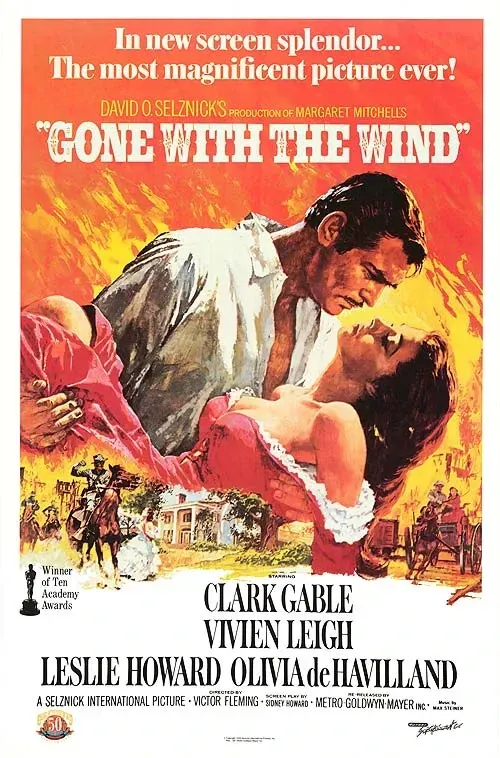
Poster from the re-release of the 1967 film
Our Aunt Raquel did the same; she never returned to ‘Spain’, though her children did. Without any hesitation or ill will, she encouraged them to visit Spain and get to know their roots and their family.
And so, over the years, they all visited their mother’s homeland on numerous occasions.
I remember perfectly the visits from Willy, the eldest and a builder, who is my age; Ailen, the ‘filmmaker’ and an excellent producer and screenwriter; and Andrew, the youngest and a vet. I have maintained a relationship with all of them and still do so today.
The fact that Raquel didn’t return to her homeland didn’t mean she wasn’t keeping an eye on us or didn’t ‘lend a hand to her sister’, apart from the Three Kings’ gifts. For years, every now and then, we’d receive a letter with a surprise:
“Mum, the postman’s brought a letter from Aunt Raquel!” I shouted; he’d just handed it to me on the landing of our staircase.
“Take it upstairs, she’s been waiting for it!”
“Can I open it?” I always tried, despite the familiar warning and reminder: 'Curiosity killed the cat.'
“Not this one, don’t let it get torn and ruin it!”
“RASH, RASH!” She tore open the envelope deftly, using her beautiful, slender fingers.
“Here it is, let’s see!” he exclaimed, pulling a piece of paper from inside. “Blimey, he’s really outdone himself! It’ll come in handy…”
This meant the cheque I’d been waiting for was inside; it wasn’t much, but enough to plug more than one hole. The difference in currency was noticeable.
The next day, it was already clear where my mother would go: straight to the Banco Exterior to cash it! In those days, we didn’t have a current account at a bank or savings bank; the little money we had was kept at home, in some hiding place known only to my parents. I suppose it was in a hole in the wall, or under a brick, the old fashioned way.
We lived from hand to mouth, entirely on a subsistence economy. It would be many years yet before Spain opened up to the rest of the world; that would come later with the tourism boom.
The first page of the manuscript of the “Song of El Cid” held at the BNE
MY MOTHER´S JOURNEYS
…Once we were older, and my mother was no longer tied down by looking after us, she was able to devote some time to herself.
We were all grown up and socially and financially independent.
Only my parents lived at home. And it was during these years that she became a modern-day female ‘Marco Polo’; she never stopped travelling to various places, not to holiday destinations advertised by travel agencies, but to reconnect with her sisters scattered across the Americas.
The first trip was to embrace the youngest, Aunt Raquel, in the North.
She crossed the Atlantic on several occasions to visit her. Almost every year she went to spend a month, or sometimes even three, with her. And she kept doing so right up until she was well into her later years!
When she returned, she came laden with gifts for everyone. The ritual of her return, which gradually became routine, went like this:
—Do you know what time Mum’s coming back?
“Yes, I do! It looks like the flight isn’t delayed, so she’s due to land tomorrow at around 6.40 pm Spanish time.” That’s how my brother Damián, who was in charge of it, would confirm the return flight to all of us.
And the next day, we’d arrive at least an hour early, children and other relatives included. Our ‘clique’ grew every year.
"Have you managed to park?"
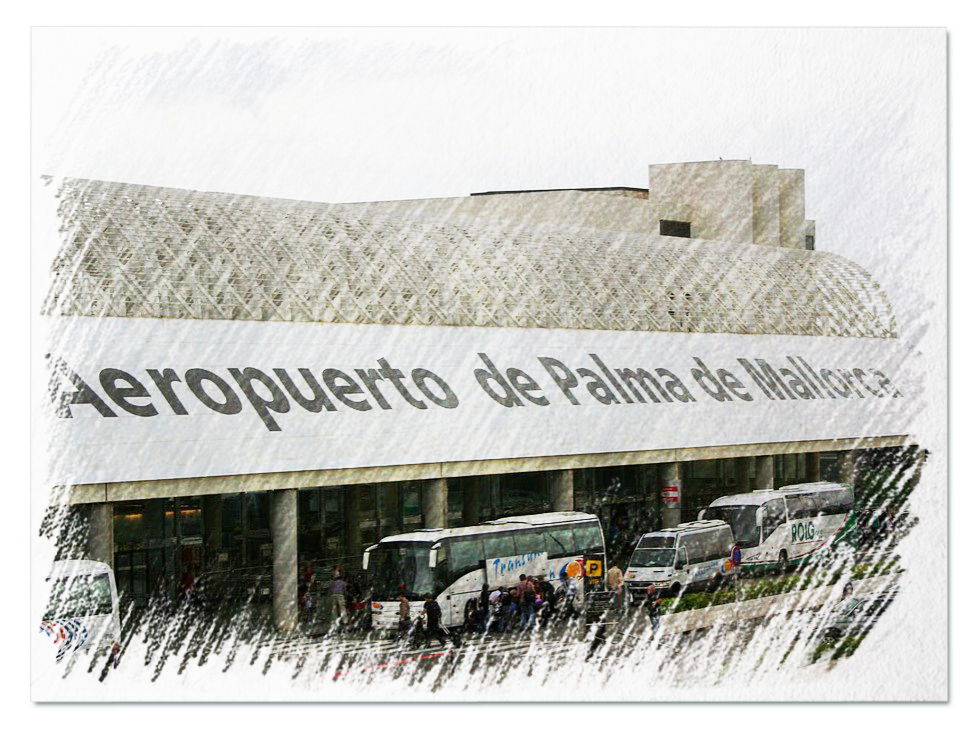
"I got fed up driving round in circles, so I’ve parked in the ‘Parking’." We were referring to the airport’s public pay-and-display car park.
In the arrivals hall, the whole ‘troop’ ended up gathering; there were loads of us. We all wanted to welcome the matriarch.
Whilst we waited, we caught up on each other’s news:
“So, how’s your daughter’s job going?”
“Very well, she’s been made permanent!”
«DING DONG, ARRIVAL OF FLIGHT SO-AND-SO, FROM…» The long, awaited announcement over the loudspeakers of my mother’s flight landing and disembarking.
That day we were all waiting for her ‘figure’ to appear in the arrivals hall; the current security measures weren’t in place yet. And it wasn’t long before she appeared:
"Look, look, it’s Grandma!’ said one of her granddaughters" I can’t remember which one.
My mother, the traveller, had already ‘surprised’ us.
The first thing she did was wave to us in a gesture of joy.
Although the rule was, to prevent luggage theft, that you weren’t allowed to go in to welcome the people you were waiting for, some of us broke it and entered the area:
“Hey! Where are you going? You can’t go through there!”
“We’re going to help my mum with her luggage! She’s the one over there!” said one of us, pointing her out to the Civil Guard, who, upon seeing her, must have been reminded of his own mother.
“Right, go on in, but don’t get in the way, I’m putting my neck on the line here!”
“Thank you so much!” We, the “advance party”, went straight over to hug my mum.
As always, she expressed her joy at seeing us:
"What a joy! I’ve been so looking forward to seeing you all again! And so-and-so; and so-and-so…"
Once we’d collected the suitcases and left the arrivals hall, it was my father who then kissed her and hugged her:
"MUA, MUA!" “We’re all here now! The kids have missed you!” he omitted to add “missed” to his own words. But my mother already knew that the one who missed her most was him.
“Come on, Damián, I’m home now!” the traveller reassured him, though she could have reminded him of his many absences of yore, but she didn’t.
Afterwards, the whole ‘brood’ set off back to my parents house.
It was like a convoy of cars.
Owning a car was now commonplace; those journeys on our ‘Vespa’ or by bus were a thing of the past.
What followed, and was repeated on every return trip; was the eagerly awaited handing out of presents. My poor mum, still weary from the long hours of flying, pulled herself together once more and began handing out the gifts. She knew exactly who they were for, although as she handed them out she changed the recipient of some of them:
"This T-shirt is for you…! This other one’s for you!" First making the little ones happy, and like a magic trick, suddenly a pair of trousers emerged from a suitcase, and six watches came out of its pocket; they were ‘cheap’ but rarely seen round here.
Most of the gifts had been bought in American department stores.
Large retail outlets had already opened in our country, but they focused mainly on food, although they did stock other products.
They hadn’t yet reached the scale of those huge shopping centres in the US.
“This one’s for you, Antoñito!” I felt flattered, not by the rubbish watch, but by the thought behind it, which was what counted. “I know it’s not much, but I hope you like it!” Those words would break you down; he knew how to tug at your heartstrings: BUA! BUAAA! SNIF! I always have a moment to think of you! You were a model of self-sacrifice for the family and everyone else...!
Continuing with the welcome party for another year. Then we said our goodbyes, but it was always inevitable that the younger ones wouldn’t be entirely satisfied:
"Mum, I want a truck like ‘X’s’ too!"
"That’s enough, your present is the best!" said his mother to calm him down.
“If you say so…” It didn’t seem as though this grandson was entirely convinced.
Two days later, when she was feeling more rested, her children would visit her; most of the time we’d all be there at the same time.
And that was when she’d tell you about her adventure; to me, she reminded me of the Antoñita of yesteryear, when I used to accompany her to give injections:
“The waterfalls really make an impression on you!” she said, referring to 'Niagara Falls'. “We were on the American side and it was unforgettable; look, I took photos of everything!” she said, enjoying showing you the pictures. “This one was taken by my cousin ‘Ailen’" Raquel’s daughter. “Who accompanied us everywhere; and this is Victoria, a friend of my aunt’s who came along too; and this is So-and-so and Such-and-such…"
She loved reminiscing about what she’d experienced, just as we all do when we see a photograph that reminds us of something pleasant.
“And these are her dogs! Any dog she sees abandoned, she takes in! I reckon she must have over fifty…”
“Well, she must be spending a fortune on feeding them!” someone asked a leading question.
“The food is delivered by lorries! She feeds them dry food!” In Spain, we weren’t yet very used to feeding dogs dry food.
“And does she belong to some sort of animal welfare organisation?”
"How should I know! She pays for the food out of her own pocket! It takes her a huge amount of work to feed them every day, and she knows them all; she knows the name of every single dog. I was helping her, I wasn’t going to just sit there while she fed them! These others are the ones that live in her house." referring to another photograph.
“Well, there aren’t that many!” I pointed out upon seeing the photo. “There must be five or six at home.”
“She keeps the others in a sort of barn! She’s got loads of land; you can’t even imagine how big the place is!”
“It’s just that the land over there is different; it’s not like here, where there’s only so much land. In America, they’ve got land to spare!” I pointed out.
“Yes, everything’s on a massive scale! They don’t mind driving six hundred or a thousand kilometres in a day.” The comparison with journeys on the island was huge, though not so much with those on the mainland.
“And are you going back next year?” I asked her.
“I don’t know! I’m tired now; the journey’s very long and it takes ages to tell whether it’s day or night, it takes a while for your body to get used to it.”
The disruption to your routine is brutal on this sort of trip, but as the months went by and she got back into her usual routine, she was already looking forward to the next journey.
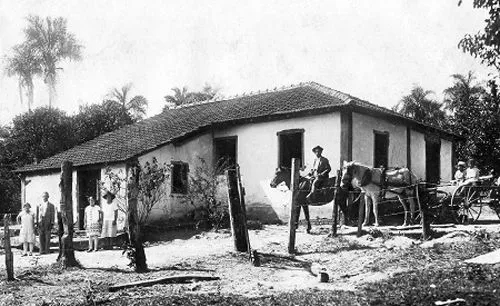
Aunt Sunti and her family's ‘ranch’ in Venezuela
AND ANOTHER YEAR IN "VENEZUELA".
One year, my mum went on a completely different sort of trip: instead of bringing things back, she took things with her to her destination.
"I reckon these are the ones he asked me for?" my mum asked herself as she was packing one of the suitcases.
“I don’t think so! They’re not ‘Adidas’, which is the brand your grandson wants.”
“Bloody hell! I’ve had enough of this! If you think I’m going to spend two thousand and something pesetas on a pair of trainers, you’re wrong! These are perfectly fine for them!”
My mother’s reaction was understandable; it turned out that the ‘gifts’ list our aunt ‘Sunti’ (Asunción) had sent to her sister specifically stated the brand they wanted. And this infuriated my mother, as they cost ten times more than other brands, as I recall happened with those bloody trainers. The same thing happened with some headphones; they wanted the 'Sony' brand, the most expensive one. The thing is, back then, Venezuelans hadn’t yet come to terms with their new economic situation. The country’s economy had plummeted.
“Well, this is what I’m taking with me! I’d rather give them the money we’re going to save, and let them buy… whatever the hell they want!” there went the usual “hell”.
She went on her planned trip and had a good time.
He met all the children of his two sisters, who had emigrated around the time my father went to try his luck there in the mid-1950s.
He was particularly delighted to see his nephew Lisardo again, the son of his late elder sister Consuelo; he was already a grandfather.
When he returned and gave us the lowdown, he confirmed what we’d already suspected: everything there had gone to hell and they were going through quite a lot of hardship. At the current exchange rate, the ‘bolívar’ was worth next to nothing.
Nothing like the better days of their economy.
The young people received the gifts, which were intended for them, but they weren’t particularly pleased, as they’d been hoping for the specific brands they’d asked for.
After this first trip to Venezuela, he made another the following year. But this time he planned it differently:
"Mum, you’re not taking any presents with you! Are you sure?"
"Whatever I take them, the kids never think it’s enough! It’s best to give them money so they can buy whatever they want."
"But they can’t find the brands they like over there."
“Well, let them make do! That’s the best thing, believe me, you lot don’t know how things are over there!”
And her decision paid off; when she arrived, she tried to keep everyone more or less happy:
“There was no need, Antoñita!” a phrase we use all over the world.
“Take this money; it’s from your cousins!”
"All right, if that’s the case, I’ll take it!"
"Of course, we’re not going to let them down!"
My mother had organised a small collection among us, and we all chipped in; we weren’t exactly rolling in it either, but it helped them a little.
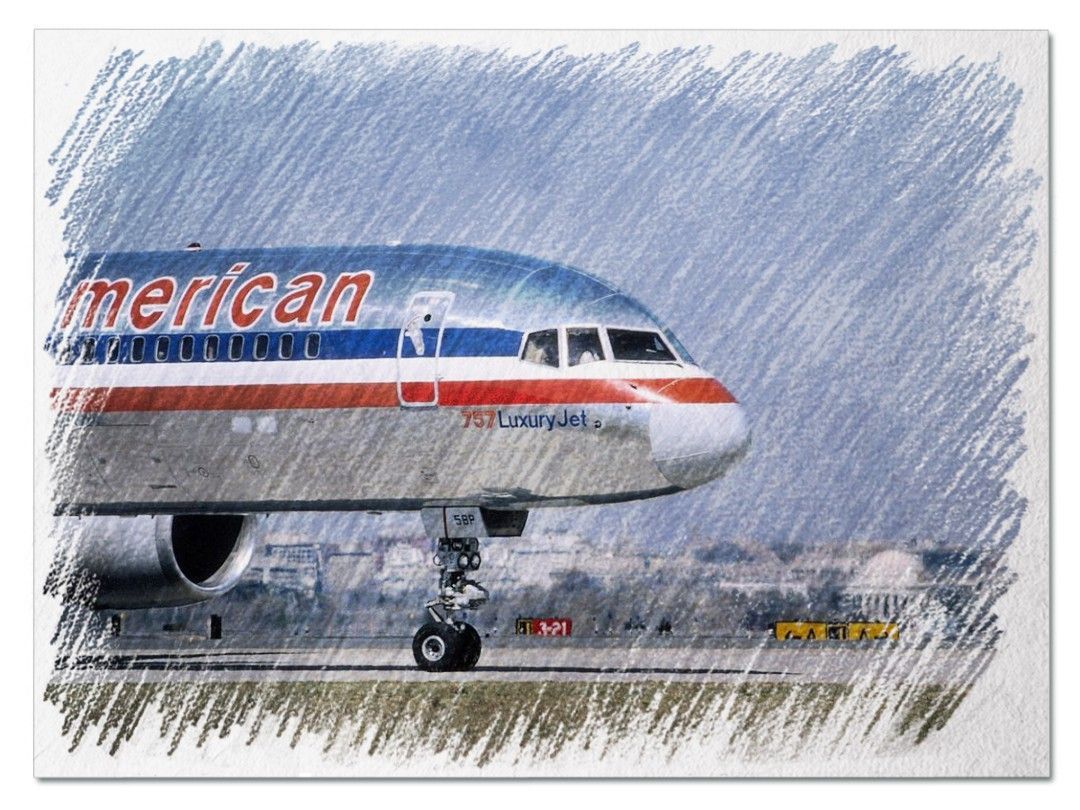
Airplane operated by 'American Airlines Flight'
THAT WAS A CLOSE CALL...!
Our 'Marco Polo', final journey took place a month before a date that would change the world: 11 September 2001.
That was precisely the date she was due to return to Spain. But luck was on our side, and my mother missed one of the connecting flights she was due to take to complete her journey. It turned out to be one of the four that the terrorists hijacked.
And she was able to return safely to our city’s airport. Amidst the turmoil of the attacks and the chaos, we feared the worst:
“She’s running late, but she’s coming! It wasn’t her plane!” Once again, my brother reassured us all with the latest news. That year, my mother was 76 years old!
It turned out that 'American Airlines Flight' 77 was the third flight hijacked as part of the attacks of 11 September 2001, and was deliberately crashed into ‘the Pentagon’, the headquarters of the 'United States Department of Defence'.
The plane, which was flying from Washington Dulles International Airport, near Washington D.C., to Los Angeles International Airport, in the city of the same name, was hijacked by five Saudi jihadists from the ‘Al-Qaeda’ terrorist network 45 minutes into the flight. The Saudis entered the cockpit and forced the passengers to move to the rear of the aircraft. Hani Hanjour, the leader of the hijackers, took control of the flight as pilot.
Unbeknownst to the hijackers, only one passenger managed to make a call to his family to tell them what had happened.
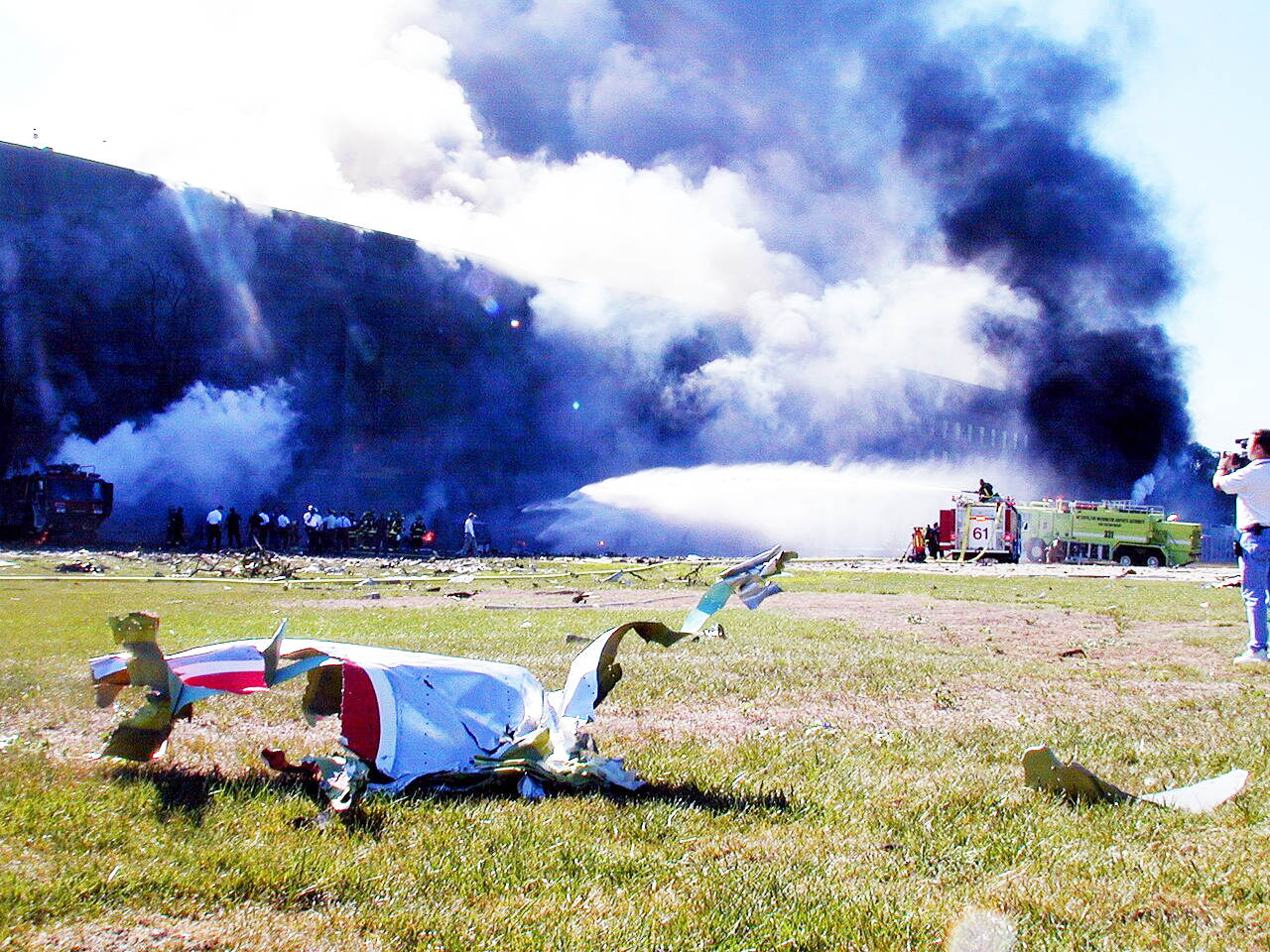
Wreckage from Flight 77, the third hijacked flight.
The plane crashed into the west facade of the Pentagon at 09:37:44 ET, killing all 64 people on board (2 pilots, 4 flight attendants and 58 passengers), as well as 125 people inside the building.
Dozens of people witnessed the incident, and within minutes the news began to report on it. The impact caused damage to a large part of the building and sparked a fire, leading to its partial collapse; the fire was fought by firefighters for several days. ■
END OF CHAPTER 5.
ATTENTION!
All rights to this novel are reserved.
Reproduction in any medium, whether in print, on the radio, on television or on the Internet, is prohibited without the prior written authorisation of the author of the work.
Reproduction of a small portion of the work is permitted for promotional, critical or similar purposes.
Registered in the SPANISH INTELLECTUAL PROPERTY REGISTER – EUROPEAN UNION (EU):
© 05/2023/121 No. 00765-01261862
Legal Deposit: AS 02505-2023 (Spain - EU).