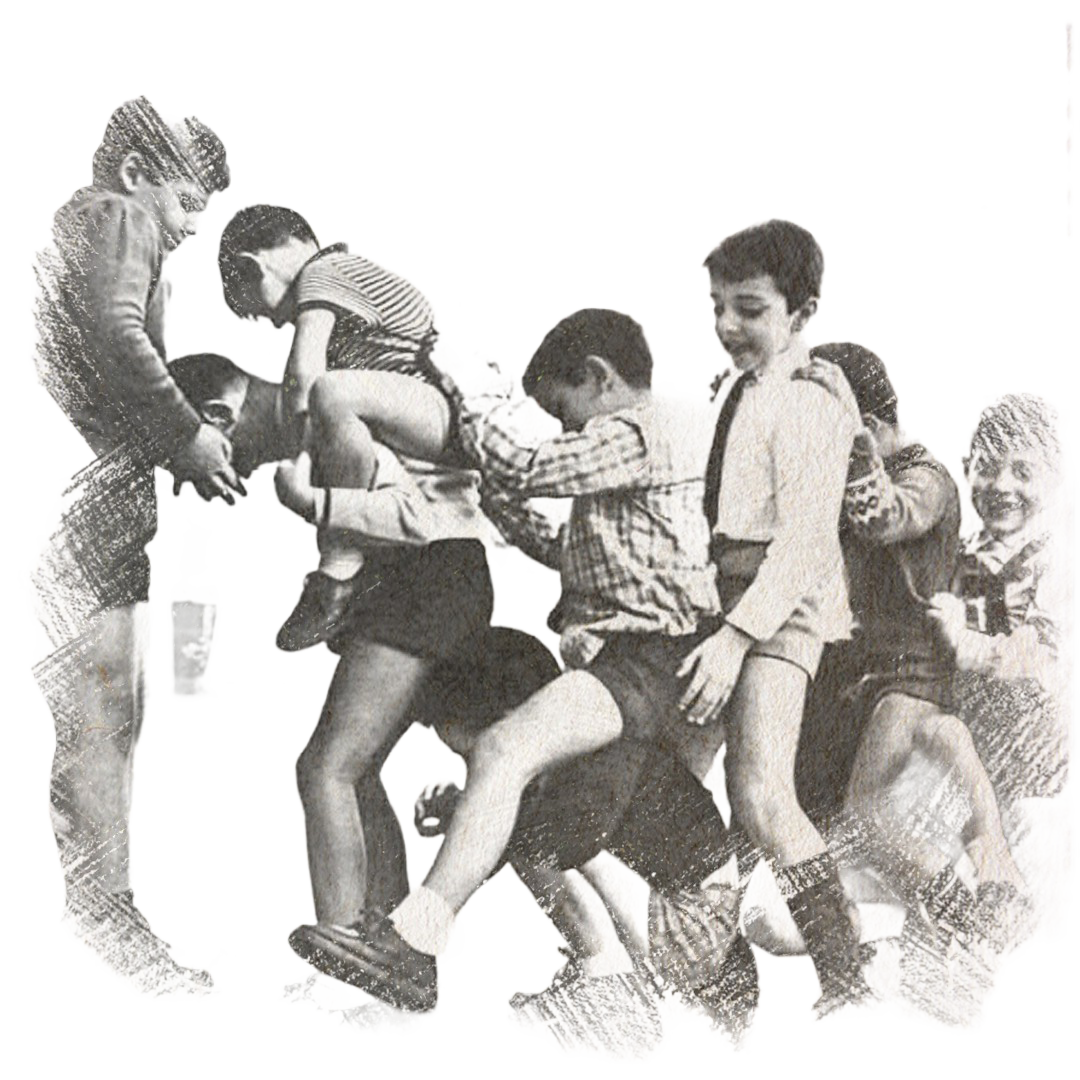
Children playing «Wrist, forearm, upper arm»
And so the long-awaited day in September arrived: the start of my, shall we say, official ‘ ’ studies. It was 1962 and I had just turned five, a proper little lad! I was leaving behind the hated nuns and their world of donkey-ear headbands and all manner of headbands, used to publicly highlight or ridicule the actions and learning of the nursery school children. Naive me, I had no idea what was in store for me! I would even end up missing the ‘pinches’ from the nuns.
“You like the satchel, don’t you?” exclaimed my mother, seeking my approval of the bag.
“It’s very nice, it’s just like my brothers, so, Mum, I’m a big boy now!” I exclaimed happily; as we all know, we children set ourselves little goals, and once achieved, it’s as if we’re growing up a little more.
It was a ‘professional’ satchel, made of good-quality brown leather, which would form part of my kit for years to come. A satchel designed to last, built to be ‘bombproof’, and the more years that passed, the more beautiful and rugged its leather became. The latter seemed like a sort of premonition, touch wood!
With this “bundle”, which was empty for the moment, I set off for the “Colegio Público de El Vivero”; the school had taken its name from the neighboring district where it was located.
In this case, my escort consisted of my two older brothers and a large group of children, most of them from the same street or neighboring streets, who deliberately went to school together. This way we avoided unwanted fights with the inhabitants of these ‘lands’; that is to say, the children who lived in this neighborhood. For in those days, outsiders were greeted with sticks , or a good thrashing, depending on the age and size of the youngsters. Over the course of the year, hatred would build up, which was ‘expelled’ in a great final battle, usually held once the school year had ended, around July.
What’s more, the fact that we all travelled in the same convoy ensured we arrived on time. The girls went their own way in small groups of three or four friends. This animosity towards visitors from outside the neighborhood didn’t apply to them, so they had no trouble at all as they made their way through this unfriendly territory. They were respected by everyone, including the other local girls in the neighborhood.
“Are we all here now?”
“Domingo’s missing, he’s ill, but everyone else is here!”
“Right then, off to school!” It was the group leader giving the orders; he was usually the oldest among us. That year, the role fell to Guillermo, who was in his final year at ; the following year, having turned 12, he would start working. His family desperately needed the income he could bring in from his future job; his father had left for Venezuela a few years earlier. Like so many other emigrants before him, he was seeking better-paid work and a higher standard of living than the precarious one that existed in Spain at that time.
So, under the guidance of ‘our idolized leader Guillermo I’, we arrived at school; we had plenty of time to spare before the nine o’clock start. We were already in the outdoor play area well before then… a stretch of street interrupted by a large wall, which had been there before the road was built, and whose planned layout I never actually saw completed. The subsequent demolition of the old wall, which also served as a drainage channel, never took place.
The street, being protected from traffic, was ideal for us boys to play in. And only the boys; the girls, young ladies or little ladies, played in another playground inside the school building. For although the school was co-educational, the areas dedicated to each gender were in fact clearly separated and defined. This complied with the primary education law mentioned earlier, which established the aforementioned separation of the sexes.
Thus, covering almost the entire ground floor of the building, were the girls’ classrooms. Ours, apart from a small area on the ground floor occupied by the Headmaster’s office, were spread across the first floor, the only other story.
But back to the street, or rather, to the outdoor playground and ‘recreation’ area. There, as soon as we arrived, our ‘flock’ had dispersed, split up and joined groups of similar ages; in one of the groups made up of the older children:
“Come on, we’ve got time! Let’s play ‘churro, forearm, upper arm’”
“Right, we’ll form a team ourselves! You, Pedro, you and you, that makes four of us.” Another team needed to play, and it didn’t take long to form:
“Ours is missing, come over here! Guillermo, Kike and Cholo,” he said, pointing at them, “and me… that makes four of us too.” Just like the previous leader of the other group, he had been pointing at them one by one.
“We’ll start by jumping! OK?” asked the teenager.
“Great! But next time we’ll start. Paquito, you be ‘mum’!”
And the boy positioned himself with his back to the wall, taking the head of another team-mate on his stomach. The other two lined up placing their heads between the legs of the one in front, forming ‘a single body’ and standing ready to receive the members of the opposing team. Who jumped and landed on the backs of those crouching down:
“THUD!” “Ouch!” it was clear that the one who landed on his back was quite heavy.
“THUD!” the next player’s landing sounded almost as loud.
“Bloody hell, they’re heavy!” If possible, the aim was for the same youngster to be the one taking the weight, so that he’d pile on the kilos on his back; this was where the skill of the jumper lay.
“He can’t take it!” That was the trick: that he couldn’t take it and would end up buckling under the weight.
“THUD THUD!” The lad couldn’t cope with the two of them on his back; there was no need for the other two to jump. In this case, the team receiving the jumpers was deemed to have lost, and they started again in the same positions.
Had they managed to bear the weight and had everyone jumped, the first to do so would have asked:
“Wrist, forearm, upper arm?” each word referring to a part of his arm: ‘wrist’ for the wrist, ‘forearm’ from the elbow to the wrist, and ‘upper arm’ for the area from the elbow to the collarbone. The aim here was to guess which of these areas the other person’s wrist was placed in. To prevent cheating, the ‘mother’ kept watch, so the first of the crouching players would call out one of those names, for example:
“forearm”, if that was where the hand was placed, in which case they won and swapped positions; if not, they had to start again.
Of course, the game was great for strengthening your back.
We younger ones used to play gentler games, such as marbles or bottle caps against the wall. Though it wouldn’t be long before we got involved in rougher ones, just as the older lads did…
In fact, a significant proportion of children’s physical games were already played in ancient times. Just as with other mammals, these physical games among children (pups) help them develop the physical skills they will need to survive as adults.
The more modern games that are familiar to us were already being played in the Middle Ages, albeit with some variations.

The painting «Children’s Games» by Pieter Bruegel
The painting «Children’s Games» (oil on panel, 118 x 161 cm, currently on display at the «Kunsthistorisches Museum» in Vienna), painted in 1560 by Pieter Bruegel the Elder, depicts 83 different games, according to the museum’s experts, being enjoyed by 230 children. These are games that are just as familiar to those of my generation as blind man’s buff, hoop rolling, spinning tops, hopscotch, knucklebones, the queen’s chair, blowing soap bubbles, playing shop, playing with dolls, walking on stilts, others performing contortions and balancing acts, climbing fences and trees. There are also some ‘torture’ games, and even, as one might expect, some ‘naughty’ ones, featuring in this case girls, one peeing and another stirring a pile of poo with a stick. In short, this was what the artist intended: to reflect the everyday life of young children.
And the long-awaited whistle blew:
“Piii, piiii, piii! Break time is over, everyone inside, everyone to their classrooms. That was the meaning of the subliminal command coming from the whistle.
“Sir, I’m going to the first-year classroom, aren’t I?” I asked a man, who looked older than me, standing nearby.
“I can see it’s your first year,” said the man, who seemed to know the answer, “so you must go up the stairs and the first classroom on the right is yours; you’ll see a very large «one» on the side of the door.
“Thank you very much, sir!”
“Call me Mr Osvaldo, I’m your teacher.”
“Right, I’ll follow you!”
“No, you rascal! Go with your classmates; make sure you’re already inside the classroom by the time I arrive.”
He said these words in a different tone; it was a real threat. ‘This bloke didn’t know who he was messing with,’ I thought to myself. But to get off on the right foot, I took his advice and dashed off up the stairs; once at the top, I went into the famous Room Number One.
Shortly afterwards, the mysterious figure from earlier appeared in the classroom. He kept his distance from us by standing at the back of the room and, ‘puffing up his ego’, said:
“Welcome! I am your teacher; you shall call me Don Osvaldo, and during this course I shall turn you into young men of global stature; you are the future men of our country…”
His speech went on for several minutes; neither I, nor surely anyone else present, had a clue what on earth he was trying to tell us. As an adult, and now familiar with the slogans in vogue at that time, it was clear that the teacher was ‘sucking up’ to them (the slogans or instructions), which embodied the ideology of Franco’s regime, regarding education as a right of the family, the Church and the State, and so it was marked by ‘National-Catholic’ thinking. Consequently, primary education had a confessional, patriotic and social character. It was made compulsory and free of charge, and the use of the Spanish language was mandatory throughout the country.
After his subliminal message, a change of tone: “Now I am going to call out each of your names; answer when you hear your name, stand up quickly and reply by saying ‘present’. Having said that, sit back down at your desk. That’s how I’ll get to know you. Understood?!... Whenever I ask you anything, you must answer: ‘Yes, sir!’” The teacher, by telling us so much about what we had to do and what we didn’t, only managed to confuse us all: “I ll ask you again, understood?”
“‘Yes, sir!” we all replied as if we were soldiers.
We got through the first lesson on behavior and discipline without a hitch, and then Mr Osvaldo, going through the register alphabetically, began to call out the pupils one by one:
“Albares Rodríguez” The surname wasn’t said, it was omitted.
“Here I am!”
In this case, faced with this response, Don Osvaldo, as a seasoned veteran, knew he had to set an example for the rest of his pupils. The same thing happened every year: a pupil wouldn’t answer what he wanted to hear, and it was always the first on the list.
“Albares, come over here!” Tthe teacher remained at the back of the classroom, right next to his large desk in front of all the desks. The boy approached him.
“Now do me a favor and open your hands and show me your palms!”
Our friend ‘Albares’ did as Mr Osvaldo instructed and, shyly, held his little hands up; the teacher’s tone was perfectly polite, pleased that the boy had obeyed. Without us realizing it, the teacher grabbed a rather long ruler—at least a metre long. And in the blink of an eye, he brought it down on the right hand of our classmate ‘Albares’, alias the ‘scapegoat’.
—SMACK! —Ouch, ouch, that hurts!
“I told you to say ‘present’! Not ‘here I am’ or any other nonsense, do you understand?” —he said this in a different tone and very loudly, so that we could hear him clearly.
“Yes, sir!”
“Now put out your other hand and say ‘present’!”
“Present, but don’t hit me anymore!
Without answering, Mr Osvaldo gave him another ‘smack’ on the other hand:
“SMACK!” “Ouch, that really hurts, ouch!”
“I'm sure that makes it clear to you! And what about you lot, when I call, what should you say?’
“PRESENT!” We all answered in unison.
We got the teacher’s message. And we weren’t the last to learn it that way, because every year at the start of term, that bastard Osvaldo kept repeating it with his new pupils. A sort of personal teaching method that seemed to work for him and which the teachers in the following years appreciated, as we arrived already partly ‘tamed’ or ‘trained’, never better said...
No other pupil strayed from the script. From then on, the “present” would be repeated in every class, several times a day.
After finishing reading out the list of students, he mentioned us one by one again; it was a subtle way of passing the time in class; on this occasion to collect our textbook, the one that would accompany us throughout the course.
In this case, I already knew that my surname would come up roughly halfway down the list.
“So-and-so…” And it was my turn again.
“Present!” “You’re not going to catch me!” I thought to myself.
After announcing my arrival, I stood up and went to the back of the classroom, where the teacher was handing out the book that my mother had paid for in advance. It was the well-known ‘Enciclopedia Álvarez’ for Year 1. In theory, we should have been given the first book, entitled ‘El Parvulito’. But as it was out of stock, we moved straight on to the next one.
The “Álvarez Encyclopaedia”, named after its creator, the teacher Antonio Álvarez Pérez (1921–2003). It managed to cover all subjects in a single book, ranging from Mathematics to Natural Sciences, History, Geography, and so on. This resulted in a significant reduction in the cost of printing the books. This economy was further enhanced by designing the content so that the same book could be used for two consecutive years.
The merits that made the ‘Álvarez’ series the favorite among the ‘ ’ teachers did not end there. With a view to making their work easier, he created the ‘Exercise Books’, which guided the teacher through their daily lessons, a measure that partly compensated for their lack of pedagogical training – hardly surprising given their background. [Most were military men whom Franco, after the “Civil War”, placed in these teaching posts, thereby resolving the surplus of personnel within his army, no longer needed in the post-war period. But this came at the expense of the quality of education, given their complete lack of preparation as teachers].
Furthermore, in the exercises, the author himself indicated which activities to carry out in the morning and afternoon sessions during lessons.
It consisted of three volumes, each corresponding to the grade or level appropriate to the pupils’ age. ‘First Grade’: For schoolchildren up to 7 years old; ‘Second Grade’: From 7 to 12 years old; and ‘Third Grade’: From 12 to 15 years old.
Following its positive reception, the range of books was expanded to include three versions of ‘Mi cartilla’ and ‘El Parvulito’, which served to extend its audience to even younger children. And ‘Iniciación Profesional’ was added to cater for older pupils.
We supplemented the “Encyclopaedia” with writing and maths workbooks; the most popular were the famous “Cuadernos Rubio”, named after their creator, Professor Ramón Rubio Silvestre (1924–2001).
With his “method” (1956), we learnt to improve our handwriting and to perform the mathematical operations of addition, subtraction, multiplication and division.
As I recall the learning methods we used, for the subject of ‘Drawing’, we used as supplementary material a set of illustrations created by Emilio ‘Freixas’ Aranguren (1889–1976), a Spanish illustrator and comic book author, considered one of the great masters of the comic strip and one of the most important educators in the contemporary history of drawing. These worksheets, which began to appear after the “Civil War”, became known as part of the famous “Freixas Method”. In producing these popular illustrations, which were available for all ages, from the very youngest to beginners and lovers of artistic drawing, he was assisted by his son Carlos “Freixas” Baleitó (1923–2003), also an illustrator, who would later continue the series.
The folders on display for purchase covered all sorts of series – around 60 in total – ranging from an introduction to drawing through to landscapes, animals, sports, castles, trains, horses and many more.
And so passed the morning of our first lesson. At twelve o’clock, our timetable ran from 9.00 am to 12.00 pm and from 3.00 pm to 5.00 pm; once again, the long-awaited whistle blew:
“Piiii, piiii, piii!” Our class, and everyone else’s, had reached the lunch break to eat, recharge our batteries and return, as we still had two more hours of lessons ahead of us. What a day! I just wanted to get home and wolf down something, as I was absolutely starving: ‘I’m starving!!!’ said the gypsy to the non-gypsy. The reason for this ‘starvation’ was the absence, on this first day, of what should have been our usual supply of a small bottle of milk for our afternoon snack. It had been cancelled or scrapped for logistical reasons! Or at least that was what the respective teachers in each class told us, following the orders of the headmaster, Don Antonio.
Although now that I remember it a bit better, that wasn’t the case; they simply said these words:
“There’s no milk today!” That was exactly what each of the teachers said; they just failed to add: “And you’re all screwed!”
Before setting off for home, we gathered again, just as we had on the way in, in an area near the school gates. We were the same ‘pack’ as in the first lesson of the morning. We counted each other off in our heads.
“What? Are we all here already?” asked Guillermo.
“Here comes Evaristo!” said one of the boys.
“I was taking a shit, sorry!” It was typical of him; he had a weak stomach…
Once everyone was sorted, we took the same path back to our neighborhood.

THE DEATH OF BARBARA.
The next day, which was a Saturday, we didn’t have our usual religious education lesson, I can’t remember why!, but it was a welcome day off from school. I took advantage of my habit of getting up early, and first thing in the morning I was already busy with my favorite game: throwing the ball through the gap between my house and the neighbor’s. The prevailing silence, broken only by the sound of the ball hitting the ground, was interrupted when we began to hear wailing. It came from various places along the street:
‘Barbarita’s dead! The little girl has passed away!’… These were the cries of grief from Leonor, the little girl’s aunt. I stopped playing and hurried up the stairs to my house.
“Mum, Mum, what’s happening!”
My mother, who was already aware of the little girl’s passing, tried to comfort me:
“Calm down! Calm down, son! Barbarita has gone to heaven!”
“I don’t understand what you’re saying! I saw her two days ago, but they wouldn’t let me go near her to give her a little kiss.”
“They did that for your own good, so you wouldn’t catch it!”
“What was wrong with her? They told me she had a cold?
“No, Antoñito, it was measles.”
“The same thing we had? The one with the red spots that itched a lot?”
“Yes, exactly! You four gave me such a hard time!” My mother recalled that in the end all four of us children caught it.
“And why did Barbarita die?”
“The illness took her! That’s all there is to it! Don’t ask any more questions and just think that she’s in heaven now, resting.” My mother replied, trying to cut short my probing questions; she knew me and knew I’d be giving her a hard time until I understood what had happened, that was just the sort of person I was.
Although in those days, measles took the lives of many children, when it hit our neighborhood last year, we were fortunate enough that no one died. But this time, it reappeared and struck our neighbor, little Barbarita. Even as a child, I realized that this disease was a real nightmare and that, from what you heard, you could be next the very next day, as it was highly contagious. Although in our case there was no danger, as having already had it we’d built up antibodies or defenses.
That very same day, some relatives and the closest neighbors paid their respects at the deceased’s home. However, apart from them, people waited until the following day, when the funeral was ready, to go and offer their condolences to the family. And to say their ‘final farewell’ to the little girl. What a Sunday that was!
All the neighbors filed past the makeshift home funeral parlor; Barbarita was already in her coffin, which had been placed in the room just to the left of the entrance to the house, to prevent any possible infection. So only those who, despite the warnings, wanted to see her entered the room, and there were few of them. And those who had already had measles and were immune, but everyone was told not to touch the deceased, just in case they transmitted the disease.
“Well, I don’t know, and I can’t remember!” said one of those present, expressing his doubts.
“Then I’d advise you not to go and see my niece, that bloody measles is highly contagious!” advised «The Accountant», the nickname by which Rafael Ordinas was known—the girl’s uncle and one of the owners of the local wool factory.
I was one of those who did go into the room and saw her. It’s been years and I still remember her, but whilst I’ve completely forgotten what Barbarita looked like, I haven’t forgotten how she seemed to be ‘sleeping’ inside her coffin. There she was, dressed in white; I think it was the same dress she’d worn months earlier for her First Communion; but in this case, it made her look like a little princess. Surrounding the coffin, on each side, were up to four candlesticks with lit candles.
And on one side of the room, countless bouquets of flowers and several wreaths. It was quite a sight; it looked like a painting depicting spring; I stayed for a while and then left.
There was nothing but weeping in that house. In the makeshift wake area by the entrance, some chairs had been set up and were occupied by the family: Barbara’s mother and her two brothers. The father was absent; years later I learnt that her father had left for Venezuela some years earlier, ‘to make his fortune!’. I heard this phrase on other occasions throughout my childhood, in reference to other people in the neighborhood who had chosen this path, to emigrate abroad, among them my own father.
In front of Bernardina, the grieving mother, and Guillermo and Baltasar, her brothers, all of us who had come filed past.
“My deepest condolences!” was the phrase everyone uttered to them.
“Thank you for coming!” was the reply they gave, and instantly they burst into tears and sobs. If any funeral is sad, this one was all the more so for such a young girl, only eight years old.
I went over to Guillermo, who used to walk us to school, and hugged him; naturally, he burst into tears. He took me by the arm and led me to a corner of the room, and from there we went into the kitchen, a room just next door. There he calmed me down, and after a while, once I had recovered a bit, he accompanied me to the door and suggested I go home; that I had already done more than enough there.
Before I left, I realized there was a sort of murmur in the house; if you listened closely, you could make out that it was prayers coming from the mouths of some women, I think at least three, whom I had seen at other funerals; they were known as ‘mourners’. Women who were hired specifically for that purpose, to pray, and who were not related to the young woman who had died, but who, at any high-profile wake, were there with their lamentations.
“Are they relatives of yours?” I asked Guillermo to confirm this.
“Not at all! They’re the ‘mourners’; the uncle (The Accountant) has hired them; he pays them!”
With the matter cleared up, there was no helping it; it was just my nature to be curious. I left the house to make room for those who were arriving.
“Guillermo, we share your grief; we mean it from the bottom of our hearts!” Another expression of condolence, this time from a relative who had just arrived.
“I know! We appreciate it…”
“Has your mother managed to get hold of your father?”
“Well, yes! We called a number he gave us in his last letter. And he’s very upset.”
“But about coming? Are you sure he hasn’t said a word?!” he asked his nephew Guillermo, expressing his anger at this behavior from his brother who had emigrated to seek his fortune in the New World.
He didn’t even want to answer or say anything more; he kept his thoughts on his father’s behavior to himself. After all, he was his father’s blood relative, and anything he said against his father would only end up causing an argument.
“Let’s go and say hello to your mother; she looks very distressed.” Having said this, he walked over to her, who was sitting a little further inside.
I was watching all this from outside; it never occurred to me to follow Guillermo’s suggestion and slip away from the vicinity of the house in mourning. From that very spot, I saw how «The Accountant» and his wife entered the funeral parlor carrying trays of food.
“Have a slice of «coca»! It’s lovely; my wife made it.”
“Mmm! You can tell it’s homemade!” The “coca”, which is a sort of pizza or flatbread topped with peppers or vegetables, went down well with those present. Offering food to those attending funerals was a custom dating back to times in the long past. It’s worth remembering that, years ago, people travelled from far away using slow means of transport to offer their condolences. And, naturally, they were ravenous.
I too was overcome by that ‘hunger’, so to satisfy it, I went back inside and took a slice. I made sure Guillermo didn’t see me; I was embarrassed that he might think I was taking advantage of the situation to eat for free – how silly of me, isn’t it…?!
With the ‘snack’ now in my stomach, I left the house and went for a walk through the surrounding streets; during this walk, I stopped several times to finish crying. I don’t know if it was the atmosphere of the funeral or my own mind that made scenes and images of Barbarita flash before my eyes, along with feelings of guilt: ‘Bloody hell, I should have let her play with me that day!’.
Measles is a vaccine-preventable disease; it is highly contagious and is caused by the virus of the same name. It is transmitted via droplets or direct contact with nasal or throat secretions from infected people. It is less common for it to spread through the air. Nevertheless, it remains one of the most easily transmitted diseases and is probably the best known and deadliest of all rash-causing diseases.
It can be prevented by receiving a vaccine, developed in 1963 by Maurice Hilleman, whose strain is still used in the MMR vaccine.
In Spain, a measles vaccination campaign was carried out in 1968, vaccinating children aged between 9 and 24 months. The percentage of people born before 1970 who have not had measles is “negligible”; over 90% of people were already immune, having contracted it before the age of 18. But we must not “let our guard down” in the slightest; worldwide measles cases rose to 869,770 in 2019, a 50% increase since 2016, with more than 200,000 infected people dying.

The following day, around midday, the window of the room that had housed the coffin the day before was wide open. A man could be heard singing:
“♫ ♪ Painter, if you paint with love! ♪ ♫”
I went over to see who this impromptu tenor was, and it turned out to be a young man I didn’t recognize; he was dressed in white overalls and was using a brush to whitewash the walls.
“What are you doing? Have you seen Guillermo?” I asked, just to strike up a conversation with him.
“Guillermo isn’t here! He’s gone off with his mum to I don’t know where, I think to sort out some paperwork. And me, well, mate, here I am, whitewashing the walls!” And he continued with his singing:
“♫ ♪ Why do you despise your colour?”
“If you know that in heaven”
“God loves them too... ♪ ♫”
“And who told you to whitewash?” I asked him.
“Mrs Bernardina (the mother), it was her turn to do it, but she didn’t feel up to it and has handed the job over to me. You see, mate! I’ve got to whitewash the whole house… so, mate, if you don’t want to hear any more, you can go on your way!
“Yes, one more thing! Have you ever had measles?”
“Lad! You’re a real ‘little rascal’, aren’t you!” here he switched from ‘mate’ to ‘lad’, ”I know exactly what you’re getting at! Well, yes, I had measles when I was fourteen.”
“That puts my mind at rest! I’ll leave you ‘whitening’ the house and singing your Machín song, because you know… that this song is by «Antonio Machín»?
“Don’t tell me, mate! I thought it was by Marisol,” replied the painter with the broad brush, “I know it’s by Machín, my Cuban mate! By the gorilla, come on!”
It really annoyed me that he spoke of the singer-songwriter like that, although he did look a bit of a bit of a weirdo. I chose not to respond to this insult from the amateur singer and left without saying goodbye to the painter from Cuba, or who knows where the hell he was from!
That very same day, but in the late afternoon, almost evening, the funeral took place with the mass at the Church of ‘Cristo Rey’, which was in the neighboring district of ‘El Vivero’. We also belonged to this same parish. The burial was arranged, as was customary, with the body present, although given the circumstances it was decided to keep the coffin closed.
It was packed; I went with two friends of my age who were also neighbors, ‘Nenico’ and ‘Michel’; we walked there at our own pace; my mother let me go like that. In those days, it was nothing out of the ordinary for children of our age to do so.
“Are we going in or what?!” asked “Nenico”.
“I’m giving it a miss—I’ve seen enough of her! Besides, I’ve been dreaming about her all night!” I told them, hoping they’d come up with an excuse too.
“Well, I don’t really feel like going in either, it’s packed!” replied “Michel”, to which “Nenico” added another refusal:
“The truth is, I wasn’t as close to her as you were! And besides, I’m giving it a miss, I don’t want to be dreaming about her tonight either! I’ve got enough to deal with as it is, that bastard of a father of mine; I spend the whole night imagining I’m fighting with him.”
And that was how our Barbarita left us, far too young to do so, but there were many children who fell victim to measles in those years...