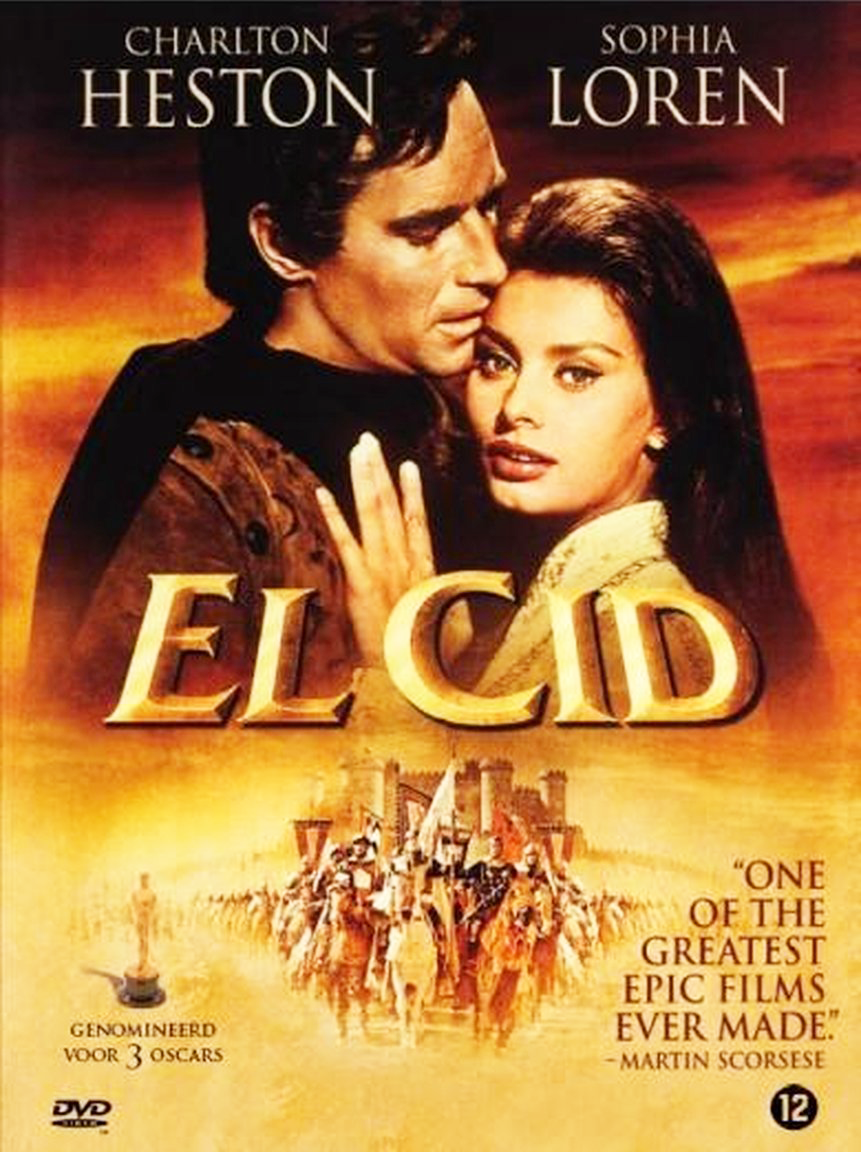
Film poster
Back then, I had two ways of finding out what was going on in the world. One was through the ‘whispers’ of the neighbours, and especially what I overheard in my godfather Miguel’s shop. That was a bit like today’s ‘Youtube', 'X', 'Instagram', 'Tik Tok', etc...
The other was through the radio; television was still a few years away from becoming popular and accessible to the working class. On one occasion, whilst I was listening to the radio, my mother interrupted me; and the attention I was paying to it vanished. This was the last thing I heard:
“Since April of this year (1961), Anthony Mann’s film ‘El Cid’, starring Charlton Heston and Sophia Loren, has been in production in Spain…”.
A film based on the life of our hero Rodrigo Díaz de Vivar (Burgos 1048 – Valencia, 1099), a Castilian military leader who, at the head of his own army, came to dominate the eastern part of the Iberian Peninsula.
During his life as a crusader, he served under various Muslim and Christian leaders. The work that has served as the main reference for our hero’s experiences, though not the only one; is the epic poem known as “Cantar de Mio Cid”. This is the first extensive narrative work in Spanish literature written in a Romance language. It consists of 3,735 anisosyllabic verses recounting heroic deeds, loosely inspired by the final years of the life of our protagonist, Don Rodrigo Díaz de Vivar…
“Come on, Antoñito, get a move on, you’re coming with me!”
“Bloody hell!” that was my muttered exclamation, a sign of my displeasure at her order. But it was nothing more than that, just a childish tantrum. And like an obedient little dog, I immediately stood up and waited for her instructions.
My mother was off to do one of her two jobs, giving an injection to one of her patients, and I was her ‘assistant’. And as such, I stuck close to her and followed her.
She did this on top of the tasks involved in looking after and bringing up four little ones of all ages, with all that entailed. And the fifth offspring hadn’t even arrived yet.
Returning to her job as a ‘banderillera’, which was also what she was known by in the area, including several neighbourhoods, that is, giving injections. It worked… thanks to my mother’s special skill for administering the ‘banderillas’ (injections) painlessly. And I can vouch for that, because in fact, I saw her give them many, many times; first she’d give a few little taps with her hand on the bum and ‘zash’… needle in. Then she’d attach the syringe to the needle and squeeze it very slowly, letting the liquid medicine enter the body. Such was her reputation that not only did people from the local area come to our house, but patients from the city also came to visit her. And on one occasion, we were even abducted by aliens from ‘Ganymede’ (a moon of Jupiter). Oops! I’ve got the wrong novel! Sorry…!
Hearing it described like that, it sounds as though she must have made a fortune, but nothing of the sort; clients paid what they could spare. That said, the minimum was usually about five pesetas, which, by my reckoning, was roughly the cost of a loaf of bread or a little more.
The downside of the ‘banderillera business’ was that, in certain cases of illness, she also made house calls; and that was when the earnings took a hit.
I accompanied him on more than one occasion, as I did on this one… Lacking transport, we walked to the houses. Come rain or shine, just like in the army, and this effort wasn’t always appreciated.
“Come on, for God’s sake, we’re running late!”
She used to say “for God’s sake” very often; it was like a sort of catchphrase.
“Mum, who’s El Cid?” I asked, referring to what I’d heard on the radio.
“How should I know!" It’s probably a brand of washing powder.” Oh dear! If ‘Don Rodrigo Díaz de Vivar’ were to hear you… The truth is, she new, but she didn’t want to get into it, as we were running late, so he just went off on a tangent like that. Without delay, we set off for the first appointment. Her competition, if you can call it that, were the nuns from the ‘Seminary’; and other nuns from the same school my sister attended. But in reality, their fees were higher; these nuns didn’t charge whatever the client felt like giving, they had a set rate; nor did they handle things with the same delicacy as my mum.
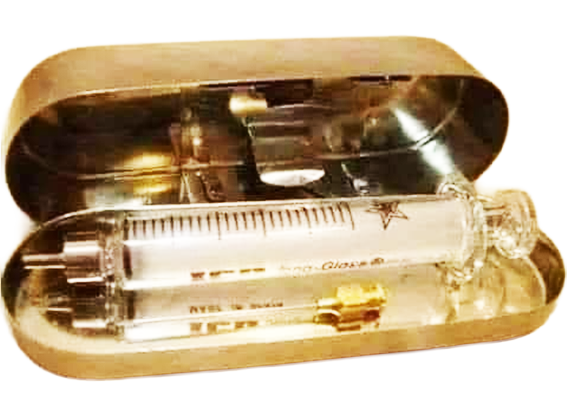
My mother's TOOL
In this case, the patient didn’t live very far away:
"TOC, TOC!" After the knocks on the door, a voice from inside called out:
"It’s open!" My mother turned the door handle and we nurses went in. "Hello Antoñita, thank you for coming!"
“Not at all!” My mother was all charm with the ‘clients’, a real saleswoman!
Ambrosia (the patient) was diabetic, an elderly woman, about sixty years old; naturally, nowadays I wouldn’t consider her that way.
“Do you have the insulin to hand?”
“Yes, it’s there, on the sideboard!”
“Come on, Antoñito, bring it to me!” At last I’d earned my pay.
“What! Are you teaching him the 'business'?”
The nurse didn’t hesitate to reply, but she had the knack of making me look good and compared me to a qualified doctor.
“Yes, when he grows up he wants to be a doctor, like ‘Doctor Vaquer’.”
The aforementioned Doctor was the local GP, but I was surprised she made that remark, when she knew full well that what I wanted to be when I grew up was a fireman; but I didn’t want to correct her…
"And Ambrosia, why don’t you learn to put them on yourself? I can teach you."
"No, no, not a chance! Just thinking about it gives me the shivers! If you don’t mind, I’d rather you did it; besides… you put them on me so lovingly!"
"You don’t need to suck up to me! Come on, pull your trousers down and show me your artist’s bum!” the patient did so, and within seconds a ‘needle’ was stuck into her buttock; I watched her closely and thought: «What a huge bum that woman has!», and it probably wasn’t any bigger than usual; I was just a boy and hadn’t yet come to appreciate this feminine feature.
After a while, the insulin was in her body, the job done, a few swabs with cotton wool soaked in alcohol and…:
"There you go, you can pull your trousers up now!"
"I didn’t feel a thing, you’re a saint!"
"Yes, ‘Saint Rita’, the one who says, ‘What’s given can’t be taken back!’
And with the job done, we set off for the next visit, but Ambrosia reminded my mother of something.
"Wait, I haven’t paid you!"
"This one’s on the house; you can pay me next time!"
"Thank you so much, Antoñita, see how you’re a saint!"
Whenever she could, my mother would lend a hand to those in need, Saint Antoñita!
On the way to our next visit, she took it upon herself to tell me a new story from her life, something she would do occasionally during these journeys; but only when she felt inspired. Her mind recalled things, without stopping her from walking:
"I remember when I’d just turned eleven; tired of seeing the bombs fall, and the destruction and deaths they caused, my mother (Asunción) decided to follow in the footsteps of the ‘Government of the Republic’ and set off for Valencia, which was where its members and entourage had fled. Those who still thought it was just a passing phase stayed behind in Madrid."
"And who was in charge? was one of my frequent interruptions.
"Everyone! It was a whorehouse!"
I didn’t ask her what a “brothel” was, as I already knew something about it; I was more concerned to know when and how they had left Madrid. I asked her and she replied:
“Well, son, just as I’ve told you! The politicians had already left earlier, when they saw that Franco was approaching and that nothing good awaited them. And as they weren’t fools! The man in charge, a certain ‘Largo Caballero’, and his whole entourage; they decided to grab everything they could and ‘take to their heels’ towards Valencia…"
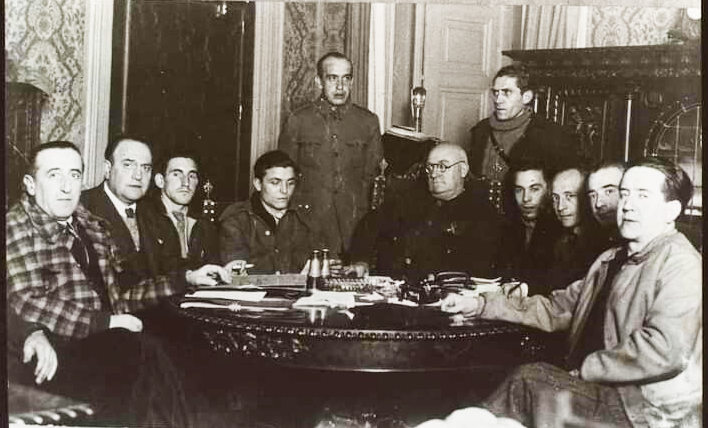
Madrid, 1936. General Miaja presiding over the Madrid Defence Council. © National Library of Spain.
As for how this exodus from Madrid came about, I found out years later that General Franco’s rebel forces were already closing in on the city. On 6 November 1936, the ‘President of the Council of Ministers of the Government of the Republic’, ‘Largo Caballero’, summoned Generals ‘Miaja’ and ‘Pozas’ and handed them an official letter in a sealed envelope, bearing the heading: ‘To be opened at six o’clock on the 7th’. This aroused the generals’ suspicions; without waiting, they opened the envelope and, to their surprise, discovered the government’s planned evacuation:
«The Government has resolved, in order to continue fulfilling its primary duty of defending the Republican cause, to relocate outside Madrid, and entrusts you with the defence of the capital at all costs. In order to assist you in this momentous task…/. a ‘Madrid Defence Council’ is hereby established…/.».
The generals decided to disregard these instructions and not even consider retreating. They chose to fight the battle to the bitter end. It was a courageous decision, and they succeeded in winning it, but from that day onwards, Madrid was fully drawn into the war…
…Having clarified this matter, I return to the moment when my mother was bringing me up to date on what she had experienced years earlier, and she continued to speak:
"A little later, my mother, your grandmother, also decided to go there. We also had family in Valencia."
This is indeed what happened, from the day after her escape, that is, 7 November, until 31 October 1937, when the newly formed ‘Negrín’ government decided to move it again, this time to Barcelona. Valencia became the capital of the Second Republic, with all that entailed. The government officials and civil servants from the various ministries also moved to this city. Trade unionists representing the various organisations, such as the ‘UGT’, ‘CNT’, etc. And all those who supported the Republic and were able to flee. In short, Valencia became the new home of this motley diaspora.
“And how did Grandma get you there?” I pressed, as she still hadn’t answered me.
“We were lucky that she had a ‘special friend’ who helped us.”
Sorry! But I need to pause for a moment; I’m sensing vibrations and signals coming from my 'Subconscious'...
"I can see where you’re going with this, you’re such a prude!"
«Why do you say that?»-
"You know full well! I bet you’re thinking that Grandma Asunción was cheating on her husband, Grandad Lázaro."
«Well, that’s what it looks like, isn’t it?».
Well, you’ve slipped up once again, 'Subconscious'. Grandad had passed away a few years earlier, leaving Grandma a widow with four girls to look after.
«I’m sorry! I apologise.».
“I accept your apology! Now let me carry on…”
I didn’t know what “taking to her heels” meant, but I didn’t dare interrupt my mother; however, this business of a “special friend” was too much for my curiosity:
“And why was Grandma’s friend ‘special’?”
“Bloody hell, what a question! He was her lover! Grandad had died and someone had to help the family out a bit…” 'Get to the point, no beating about the bush!' she clarified. I kept probing and wanted to know what the “friend” did for a living, to which she replied:
“He was a captain in the FAI; to put it simply, an anarchist bigwig (F.A.I. – International Anarchist Federation) who’d seized a big car that had previously belonged to a banker who’d fled. And yes,! we travelled to Valencia in it! The anarchist militiaman never returned to Madrid; he remained in command of one of the ‘Checas’ in Valencia.
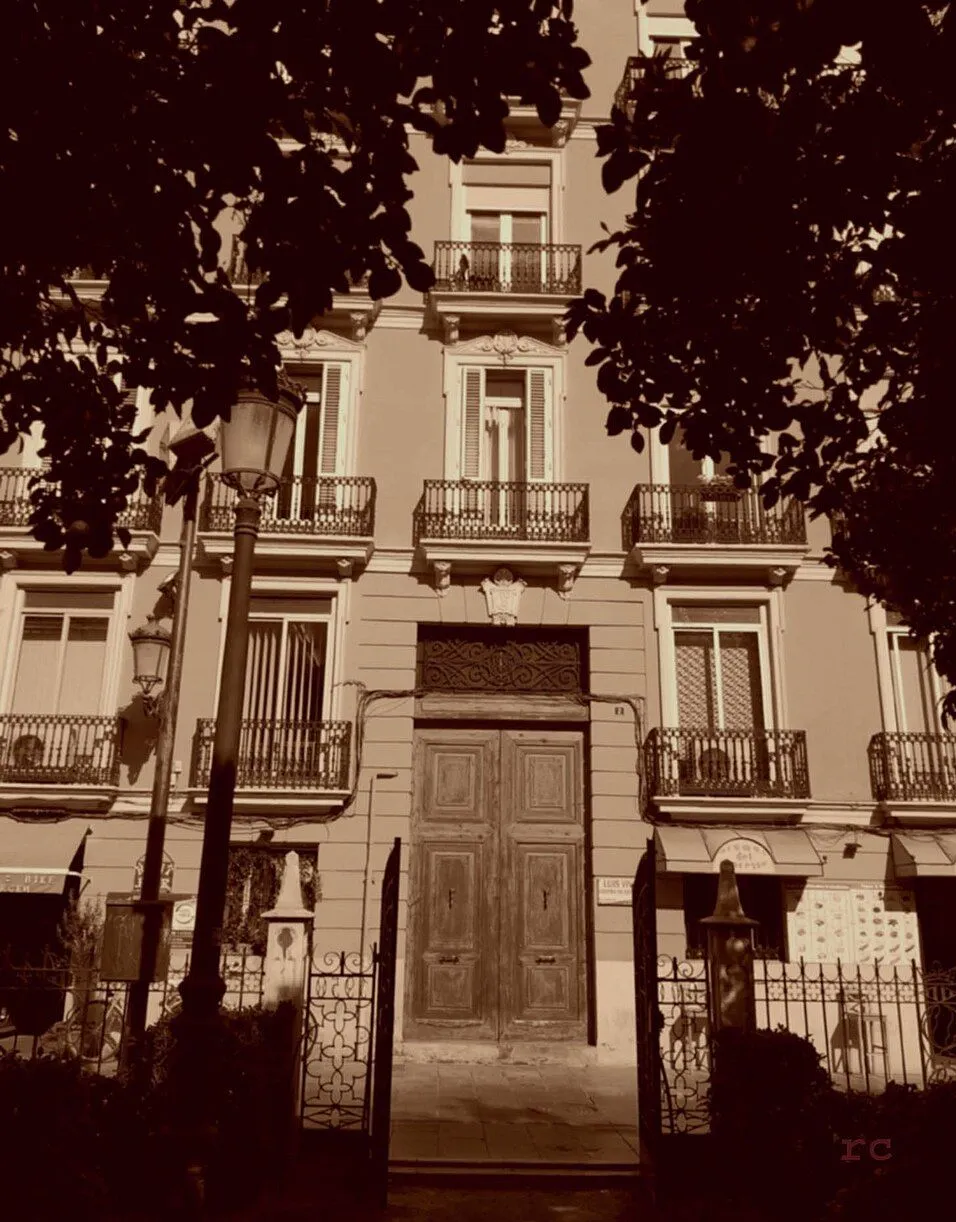
One of the detention centres for citizens, known as CHECA, in the city of Valencia
Years later, as an adult, I found out what on earth ‘the Checas’ actually were, and no, it doesn’t refer to women from the ‘Czech Republic’ (formerly part of Czechoslovakia). “Las Checas” was the name they adopted, imitating their Soviet counterparts created years earlier by Lenin; the motley collection of facilities where people of religious faith or those considered “right-wing” were interrogated and tortured. They occupied everything from former, abandoned convents to government buildings. During the “Civil War”, the Republic used them in the rear and throughout the territory of Spain under its control. Initially, they were under the control of the “Special Department of State Information” (DEDIDE); and later, in August 1937, they came under the authority of the “Military Information Service” (S.I.M.), created by “Indalecio Prieto”, a minister in the Republican government.
It was from these centres and from prisons that the dreaded ‘sacas’ took place, in which militiamen would extract and lead the detained prisoners to open fields or makeshift ‘execution walls’ outside the prison grounds, where they were killed. This practice was also carried out during the “Civil War” and in the early years of “Francoism” by the Nationalist side, known as “paseíllos”.
…But back then, unaware of all this, I didn’t pay much attention to the story about my grandmother’s ‘special’ friend’s new job, in charge of a ‘Checa’; I didn’t understand a single thing about what it was. But what I did understand was that there was hardly any room for so many passengers and their suitcases in the FAI anarchist’s car:
"And did you all “fit” in that car?"
"Well, yes, we all squeezed in! My three sisters! You know, your aunts, your grandmother Asunción and me, your mother!"
“And the ‘special friend’?” I asked; truth be told, he was a bit of a ‘tocaeggs’:
“You’re such a twisted one! He was the one driving. And that’s enough for today!... Let’s get on with the next one, for God’s sake! Don Juan, ‘Cogito’, is waiting for us; he’ll think we’re not coming.”
Don Juan was a very pleasant man with the patience of a saint; he lived opposite our house, a few metres further down the street. And that’s where we headed, but now it was time to sing one of those ‘old-fashioned’ songs my mother loved; on this particular day it was ‘Échale guindas al pavo’.
A song my mother had heard from “Imperio Argentina” when she saw their latest film in Madrid. And that was before we set off for Valencia and a few months before the Civil War began; I later found out that the title of the film was “Morena Clara”.
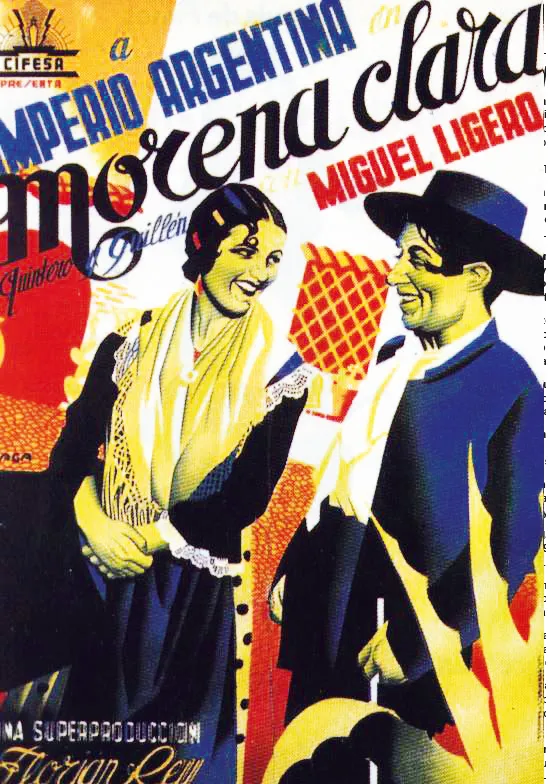
Film poster
A film directed by Florián Rey and starring the aforementioned ‘Imperio Argentina’; the lyrics, although I only managed to memorise the first verse, went like this:
♪ ♫ ♫ ♪ Fleeing from the civilians
A gypsy from the perchel
Without a plan and without a clue
Where on earth did he end up!
In a chicken coop
And what did he find there?
Well, a fine young hen
Making love to a turkey…
AND IT CONTINUES ♪ ♫ ♪ ♫
FINISHING…♪ ♫
I’ll sprinkle the hen
With sugar, cinnamon and cloves. ♪♪ ♫
Authors: Ramón Perelló y Ródenas, Juan Mostazo and Sixto Cantabrana.
The story told by the song, which is about the mischief of some Gypsies from the ‘Barrio Perchel’ in the city of Málaga, amused me; this business of stealing turkeys and the Civil Guard was also very typical of that era. Not much had changed between 1936 and 1961.
So, listening to the song sung by my mother, we soon arrived at ‘Cojito’s’ house; his wife was waiting for us at the door.
"Hello, Antoñita, we were just waiting for you!"
"Well, I’m right on time!"
"I know! It’s just that my husband wants to go to bed; he’s not feeling very well. He’s had a very busy day."
“Never mind, we’ll give him the injection straight away!”
We went in quickly; in this case, the syringe and needle had already been sterilised in a small pot of boiling water by his wife.
Whilst my mother was getting ready, I was taken aback by something in the small hall at the entrance to the house.
“Aurora, is this your husband’s uniform?” I asked without hesitation.
“Yes, it’s his dress uniform!” We were both referring to a military uniform that was draped over a ‘dress form’, a sort of ‘skinny’, headless wooden mannequin used for hanging clothes.
“And are all these medals his?” The famous “And” that no child should be without…
“Of course, Don Juan won them all!”
"And how did he win them, in a game of cards?" It was a question asked with a bit of a snide tone; I don’t know why I asked it that way; I suppose it was due to the unconscious influence of what had happened to my grandfather. Who had been on the opposing side during the war.
"Boy, don’t be impertinent!" exclaimed my mother, calling me to order.
"No! Leave him be, Antoñita, he’ll know all about this!" said his wife, trying to excuse me 'for my out of place question'.
Then a hoarse voice was heard from inside the room. ‘Cogito’ had heard me.
"Come here, you rascal!" Just what I was expecting, I thought.
“Don’t be afraid, that’s just Don Juan’s way of speaking; you can come into the room.”
I did so, but with trepidation. Inside, lying on the bed, was Don Juan, a rather thin man with, indeed, very wrinkled skin.
“Look, son! I was given these medals for my bravery in the ‘Battle of the Ebro’.”
“And was that where they took your leg off?” I continued to be impertinent.
“Yes, that’s where it was! I was hit there by a piece of shrapnel, and shortly afterwards my leg went gangrenous, so they had to amputate it.”
“Bloody hell, that must have hurt, Don Juan!” I voiced what I felt, a pain in my own leg. “And how do you manage to walk?” I asked, curious to find out; I was interested in knowing the trick he used to move so nimbly on crutches.
"It’s quite a struggle at first, but human beings get used to everything and adapt; the crutches and the wheelchair help me a lot," the military explained to me. There was nothing magical about it; it was all down to one’s own willpower to want to do it. He was a very decent man.
“Come on, son, stop questioning him and get out of the room! We’re going to pin a ‘banderilla’ on Don Juan,” my mother told me.
I did as I was told and went off, lost in thought, to take a closer look at the soldier’s medals. I tried to imagine what merits he must have earned to be awarded each one, but my mind wandered.
Years later, I learnt that ‘The Battle of the Ebro’ was a battle fought during the 'Spanish Civil War', which took place between July and November 1938. It was the battle with the highest number of combatants, the longest, and one of the bloodiest of the entire war (20,000 dead and over 70,000 wounded on both sides). It was also one of the longest (114 days of fighting) of the conflict.
It took place in the lower reaches of the Ebro Valley, between the western part of the province of Tarragona and the eastern part of the province of Zaragoza.
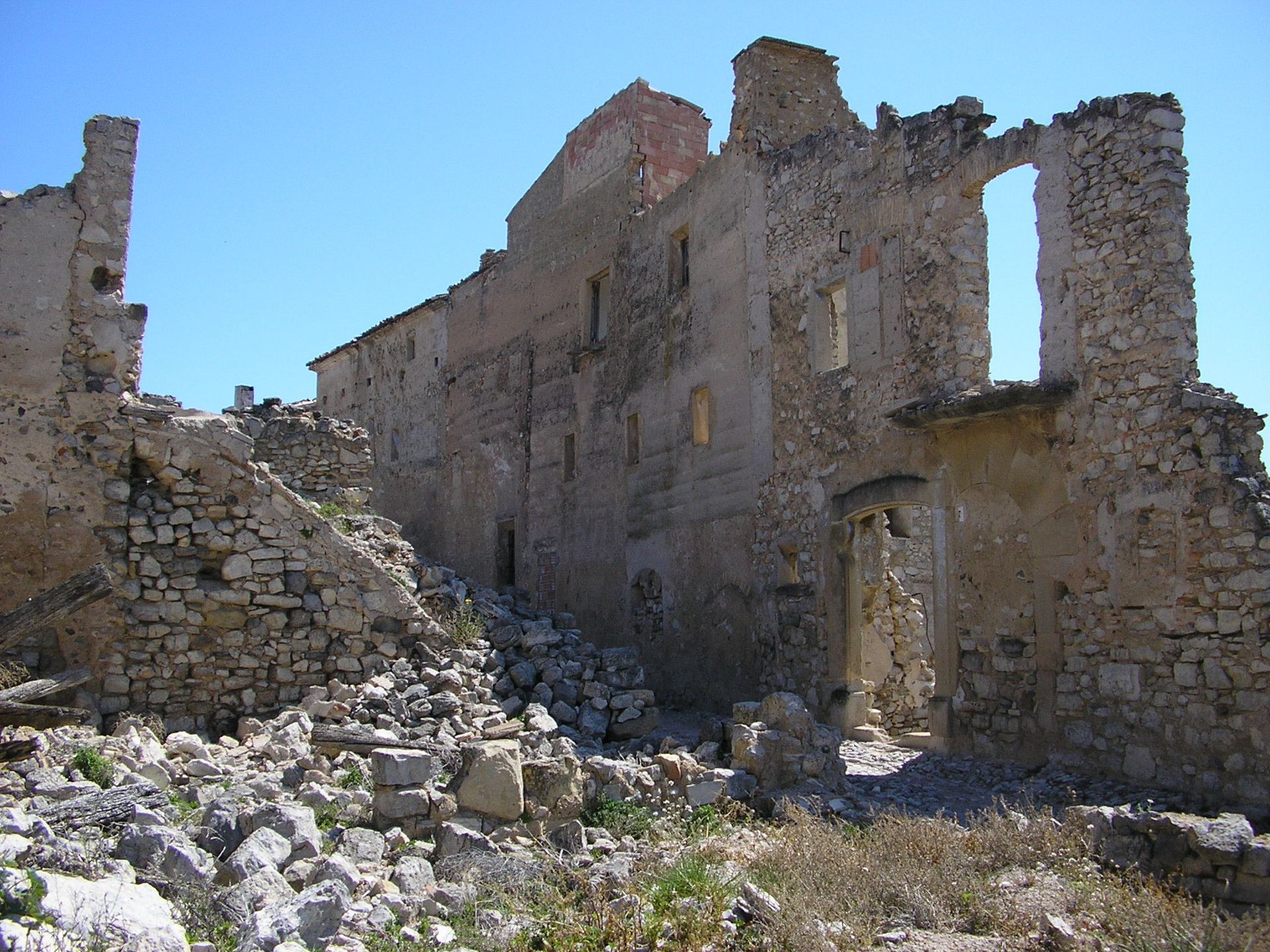
Ruins in Corbera de Ebro, in the “Poble Vell” (Old Town). The town suffered severely from artillery and air strikes during the course of the battle
…Once the work was done and I’d been paid, I don’t know exactly how much, but they paid more than the usual ‘tip’. We headed for the exit; his wife accompanied us again and I couldn’t resist clarifying something:
"Aurora, why do you call him Don Juan when you’re referring to your husband in his presence?"
"Oh, ‘Button Nose’! Now he’s Don Juan, but until a few years ago I had to call him ‘my Colonel’, it’s an army habit, and if that gives him a bit of pleasure, well, so be it!
"‘But how impertinent you are, you don’t seem like my son!" once again my mother called me to order; I knew her, and it was most likely that when we left the house she’d give me a tap on the head for being rude.
"Not at all, Antoñita, the boy’s just curious, that’s all!"
So, with my curiosity satisfied, we headed home, it was already well past time for afternoon tea! We’d had enough visits for today.
…From all this business of accompanying her, I developed a phobia of injections that still lasts to this day; if I can’t see who’s sticking the needle in me, getting the injection becomes very difficult. It’s practically impossible to give it to me in the bum.
My mother carried on giving injections until we moved neighbourhoods; she won the affection of many people and I only remember one case of a dissatisfied patient.
This is how it happened: it turned out that a ‘pot-esser client’ (maybe), who came to our house to have her injection, once it was already in, gave the syringe a ‘slap’. The needle broke and, with such force that a piece remained lodged in her buttock, she had to go to the clinic to have it removed. Over the next few days, the ungrateful client came round every day, threatening to report her if she didn’t pay her a sum of money. In the end, my mother gave her ‘the cash’, though I don’t know how much—just to make her go away. This affected her so much that she went many months without giving a single injection to anyone in the neighbourhood. But by dint of their persistence, the spoiled patients managed to get my mother back to ‘work’.
There was also another very special patient who drove us all up the wall, never better said. Her name was Coloma (Paloma); she was a mother who came accompanied by her daughter, known in the neighbourhood as ‘La Nineta’ (‘Little Girl’), who was a bit off her rocker. They weren’t very used to the ways of the neighbourhood, as they were from the countryside and made no secret of it. They came every day for the injection in question, fortunately except on Saturdays and Sundays, which they spent in their village, where another ‘banderillero’ gave them their injections.
Around seven in the evening, there would be a series of knocks from old Coloma on the stairwell wall; from downstairs, she made them as if singing a song:
"TOC TOTOTOTOCCO TOCTOC! (My dear children…! Goodbye!)." the same one my father used to knock when he went to my grandparents’ house; it seems it was the fashion.
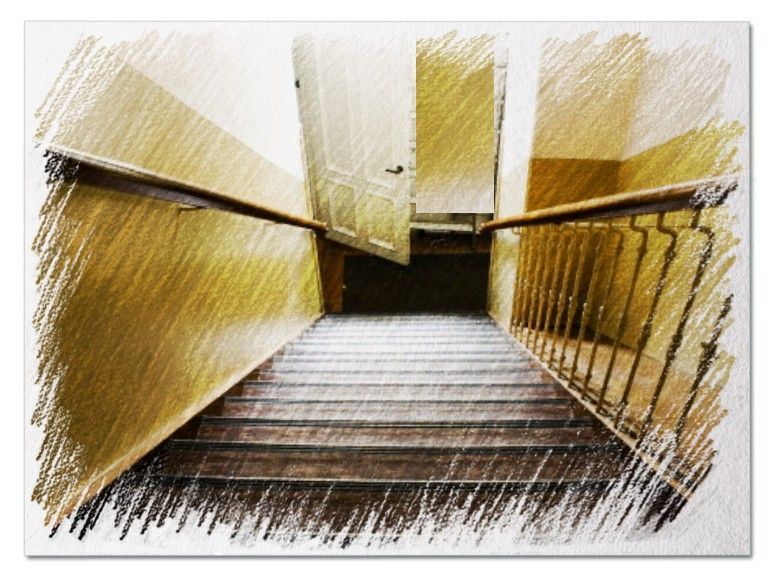
The steep staircase in our house used to make you feel dizzy!
It was a signal for my mother or whoever was around to come down and help her up, as ‘La Nineta’ on her own wasn’t enough.
Whoever was nearby would come down and help them up the steep staircase of our house. My mother would give her the injection, and the old woman would go off to ‘get some fresh air’.
“I wish there was someone like you in the village; you have the hands of a saint, my dear!” said another woman, treating Antoñita, my mum, like a saint.
I remember that one fine day she stopped coming; it turned out the old woman had fallen ill and the two women had gone back to live in the village. We heard nothing more of them for over a year, until ‘La Nineta’ turned up at our house accompanied by her boyfriend. Yes; the one who didn’t seem to be in the mood for courtship had found her ‘soulmate’. And more surprises! They came to announce their upcoming wedding; the old lady was missing, having gone a few months earlier to play the 'TOC TOTOTOTOCCO!' for Saint Peter.
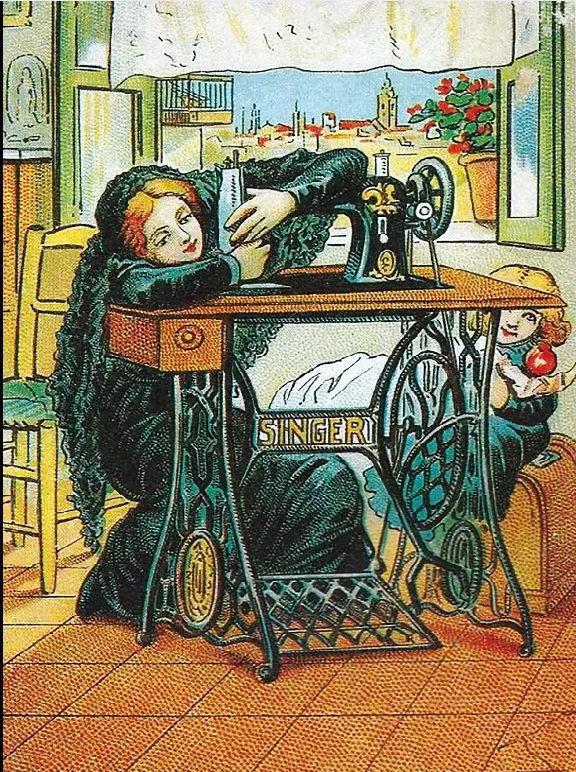
Advertising poster for SINGER sewing machines
…And as I mentioned earlier, my mother had two jobs – what’s known as moonlighting. And she didn’t do it on a whim; it was out of sheer necessity… Her other job was as a seamstress, and with these two jobs she managed to contribute to the family budget. Which, as was the case for most families, was never enough.
She sewed on the various machines that came and went through the house, from the pedal-powered one to the electric one; with them she made all sorts of garments: trousers, shirts, jackets, and so on. She also made curtains and tablecloths. But the real income came when she was hired to do regular mending or alterations to clothes. Her client was a department store in the city; twice a week, a man in a van would bring her new orders and collect the finished ones. Another man also came every week and brought her an envelope with money. As it happened, a few days later, whilst the ‘troop’ was in the living room, the doorbell rang:
"DING, DONG!" Isa, go and open the door, it’s Mr Miralles!"
It was the only visitor my mother was expecting that afternoon, and she assumed it was him. My sister went to the door and opened it immediately…:
“Come in, Mr Miralles, my mother is waiting for you!”
Without saying a word, the man entered the house and followed my sister, who led him into the dining room. He was a man of few words, or rather, a rude one.
"Hello, Mr Miralles! Shall I sign the receipt?"
"Yes, Antoñita, here’s your money! As always, it’s in the envelope, and this is the receipt you need to sign." Without looking at what was written on the receipt and without counting the money in the envelope, my mother signed the document; despite it being money paid to her for her work, our need for it made her behave as if the company were doing her a favour by paying her for the garments she had made.
"Right then, Antoñita, see you next week!"
"See you then, Mr Miralles!" she said, accompanying him to the door.
Once the paymaster had left, my mother opened the envelope, took out the money and counted it:
"One hundred and fifty-two pesetas. Don’t even touch this money! We’ll use this to pay this month’s instalment on the machine." She was referring to her latest purchase, her new sewing machine; what’s more, it was electric and could even do embroidery.
That’s how this ‘industrial’ sector worked, and thank goodness, for many families survived on this income; most companies didn’t declare it or pay tax on it. ■
END OF CHAPTER 4.
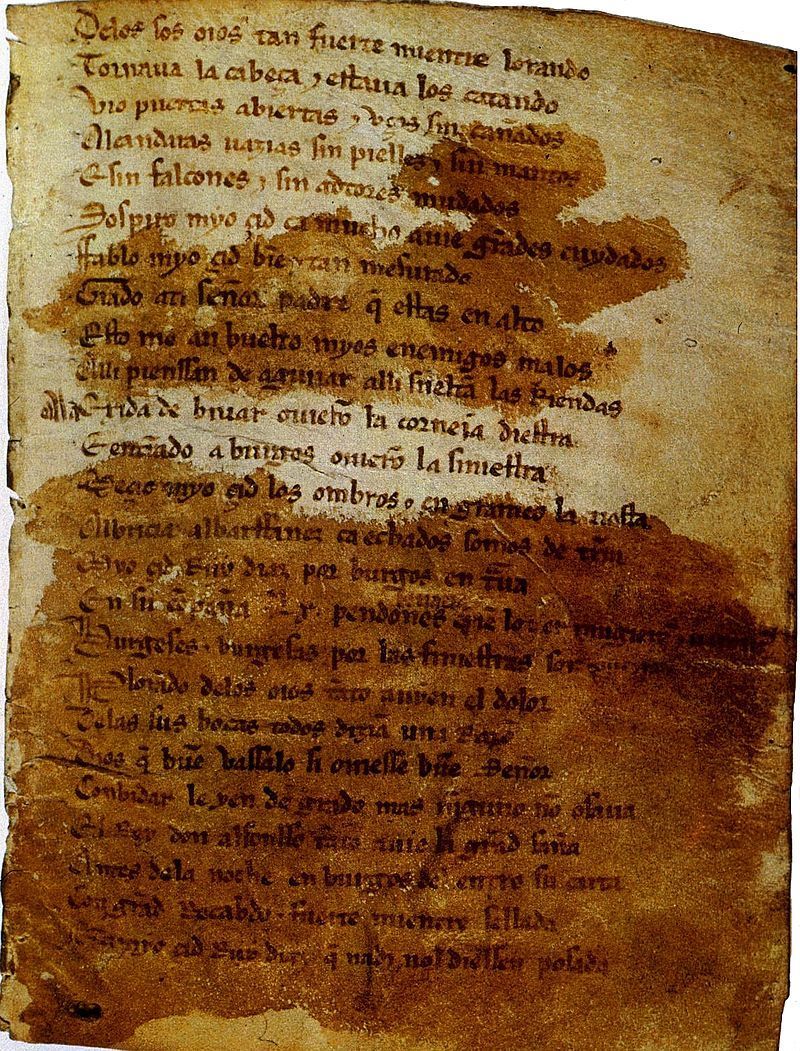
The first page of the manuscript of the “Song of El Cid” held at the BNE
Find out more about:
“El Cantar de mio Cid”
“The Song of El Cid”
...is the oldest surviving Castilian epic poem. Based on a true story, it recounts the exploits of the Castilian hero “Rodrigo Díaz de Vivar”, known as El Cid; and is set during the 11th century, a time of war on the Iberian Peninsula between the Kingdom of Castile and various Taifa principalities of Al-Andalus.
It is considered a national epic of Spain. The work is preserved in a medieval manuscript now held at the National Library of Spain. [↑]
The story begins with El Cid’s exile, after his enemies had unjustly accused him of stealing money from King Alfonso VI of Castile and León, leading to his banishment. To restore his honour, he takes part in battles against the Moorish armies and conquers Valencia. Thanks to these heroic deeds, he regains the king’s trust and his honour is restored. The king personally marries El Cid’s daughters to the infantes (princes) of Carrión. However, when the princes are humiliated by El Cid’s men for their cowardice, the infantes swear revenge. They beat their new wives and leave them for dead.
When El Cid learns of this, he pleads for justice from the king. The princes are forced to return El Cid’s dowry and are defeated in a duel, stripped of all honour. El Cid’s two daughters then remarry the crown princes of Navarre and Aragon.
“The Poem of El Cid” (also known by this name), unlike other medieval European epics, is written in a realistic tone; there is no magic, and even the appearance of the Archangel Gabriel (which occurs in verses 404 - 410) takes place in a dream. However, it also departs from historical truth: for example, his son is not mentioned, his daughters were not called Elvira and Sol, and they did not become queens.
It consists of over 3,700 verses, usually 14 to 16 syllables each, with a caesura between the hemistiches. The rhyme is assonant. ■
ATTENTION!
All rights to this novel are reserved.
Reproduction in any medium, whether in print, on the radio, on television or on the Internet, is prohibited without the prior written authorisation of the author of the work.
Reproduction of a small portion of the work is permitted for promotional, critical or similar purposes.
Registered in the SPANISH INTELLECTUAL PROPERTY REGISTER – EUROPEAN UNION (EU):
© 05/2023/121 No. 00765-01261862
Legal Deposit: AS 02505-2023 (Spain - EU).